Contact Info
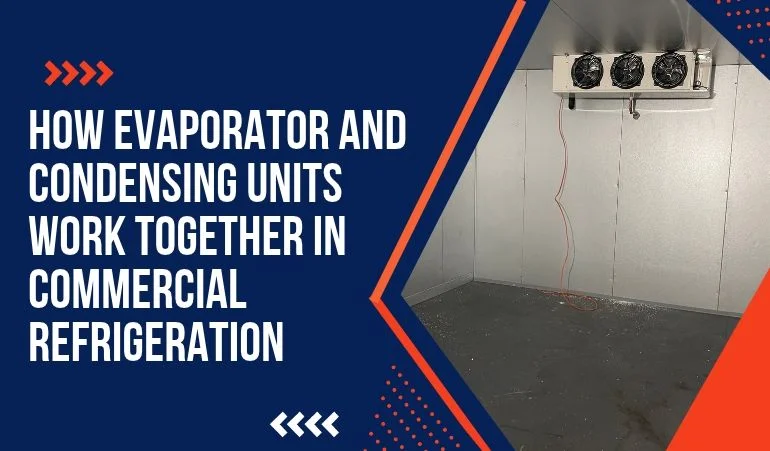
When we talk about the commercial refrigeration process, two components instantly come to mind: the evaporator and the condenser unit. These two work in coordination and keep the stored goods at the temperature they require. The evaporation component absorbs heat and turns the refrigerant from liquid to gas, while the condensation unit releases heat and changes the refrigerant from vapor back to liquid. This is the essential process that keeps on repeating in every refrigeration process.
This blog covers how evaporator and condensing units work together. It also includes a real case study by Lehigh HVAC.
An evaporator is a very critical component of a refrigeration system. It absorbs heat and turns the liquid refrigerant into vapor in a space where cooling is required. The refrigerant flows in the refrigerant lines and reaches the evaporation component, which largely consists of coils.
The evaporator's main functions include:
Absorbing heat from the refrigerated space.
Changing low-pressure liquid refrigerant into vapor.
Supporting the required cooling temperature.
Circulating cooled air through the storage area.
The role of a condenser is antagonistic to the evaporator, and it works where heating is required. It releases the heat and converts the refrigerant from vapor to liquid form. This is required when heating is the demand. The apparatus of the condenser unit is also similar to the evaporator unit, though the coil length may vary depending on the temperature required and the level of refrigeration needed for the goods.
The main functions of a condensing unit include:
Compressing refrigerant vapor to a higher pressure.
Circulating refrigerant through the system.
Releasing absorbed heat through the condenser.
Supplying liquid refrigerant to the expansion device.
Refrigeration actually happens when both evaporator and condenser units work together. Here is how the process works step by step.
The evaporator absorbs heat from inside the refrigerated space, causing the liquid refrigerant to evaporate into a low-pressure gas
The compressor draws in the low-pressure gas and compresses it into a high-pressure, high-temperature gas
The high-pressure gas travels to the condenser coil, where heat is released to the surrounding outside air, condensing the refrigerant back into a high-pressure liquid
The high-pressure liquid flows through an expansion valve, which reduces its pressure and temperature before it re-enters the evaporator to repeat the cycle
To keep the refrigeration system running correctly, both units should work ideally and perform their intended functions. If one of them gets out of order, the system refuses to perform its functions. The result is that your goods get destroyed over time.
In many cases, poor maintenance, obstructed airflow, or aging components restrict the units from performing their functions. Some additional causes can also be behind their reduced performance, such as
Incorrect refrigerant charge.
Damaged or inefficient fan motors.
Restricted refrigerant lines.
Faulty expansion valves.
Compressor performance issues.
When Flaming Hot Halal Grill needed a complete refrigeration system upgrade in Pennsylvania, Lehigh HVAC evaluated the facility and implemented an end-to-end solution. The installation was carefully planned around active restaurant operations to minimize disruption to staff and customers. Technicians mounted and secured the evaporator and condenser units for optimal performance, installed heavy-duty insulated refrigerant lines to preserve thermal efficiency, integrated centralized controls, and sealed walk-in cooler panels to prevent energy loss. Thorough testing and commissioning of both units were also performed, including temperature sensor calibration, line pressure checks, airflow verification, and centralized control testing to ensure seamless operation.
If you need trustworthy technicians for your commercial refrigeration project, call Lehigh HVAC for a quote.