Contact Info
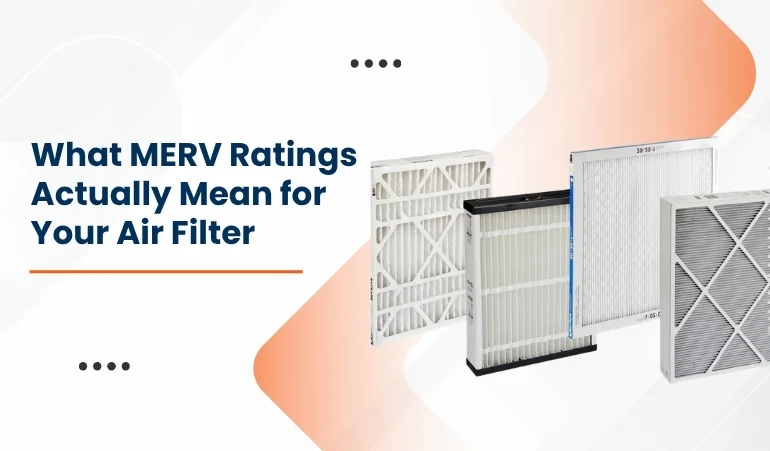
MERV stands for Minimum Efficiency Reporting Value. It is an industry standard for knowing how effectively an air filter can trap small particles in your home. The standard MERV scale for air filters ranges from 1 to 16, with 16 being the finest filters on the market and 1 the oldest. The choice of the right MERV filters doesn't just influence quality, cost, or air filtration. It influences how healthy the air is in your indoor environment and how healthy your family actually is.
That’s why having the right knowledge of MERV ratings is essential to make the right choice. This blog explores what a MERV rating is, what it means for air filters, and what MERV you should aim for in your residential HVAC systems. The guide specifically focuses on the HVAC market, climate, and demands in the Pennsylvania region.
MERV ratings matter because they directly decide the indoor air quality, how hard the HVAC system has to work, and what figure you are going to see on your utility bill this month.
Higher MERV filters efficiently remove even small particles. It translates into a reduced risk of allergies, asthma, and other serious syndromes.
Lehigh HVAC experts continuously state that choosing the right MERV filters has a direct effect on HVAC performance and efficiency. Though choosing MERV beyond your system’s capacity is never a good choice.
The right filter keeps airflow balanced and energy bills in a reasonable range. But if you choose very dense air filters, they will block airflow, forcing the HVAC to work harder. It leads to premature wear on the components, reduced efficiency, and higher bills.
The scale ranges from 1 to 16. But we mainly divide it into 4 categories. The higher the rating, the better the filtration capabilities, provided it matches the system’s efficiency.
They offer a very basic level of filtration capabilities, filtering out large debris only. They are generally suitable for indoor environments where there is a separate air filtration system. Or they might be used in some areas where homeowners are pretty sure that air quality is already good.
These are just one step ahead of the previous category. MERV 8 filters are still in high demand in Pennsylvania for standard residential HVAC units. The fact is that MERV 8 filters are the most widely produced and purchased air filters in the market so far. Lehigh HVAC technicians, however, suggest voluntarily upgrading to MERV 11 or 13 filters for better indoor air quality.
This is the medium efficiency category. Filters in this range are good at filtration but less than the top category. MERV 11 filters are very popular in this category and frequently used in various residential and commercial HVAC systems.
This is the finest category available so far. MERV 13 and 16 filters are the popular choices here. At Lehigh HVAC, we suggest MERV 13 filters for most average projects where air quality is just average. But if someone is extremely health-conscious or in a place with very high levels of contamination, MERV 16 is the best choice.
While MERV ratings are an industry standard for air filter functionality and filtration capability, modern industry now prefers something beyond MERV. This is a HEPA (High-Efficiency Particulate Air) filter. They are the mechanical gold standard, as they can trap up to 99.97% of particles up to 0.3 microns. These are the best filters for indoor air in your residential or commercial facilities.
HEPA filters are excellent, but that doesn’t mean they are equally good for standard HVAC systems. The fact is that most home furnaces choke on true HEPA filters because their dense fibers restrict the airflow.
MERV ratings are a standard grading criterion for air filters. It shows how well an air filter can capture small airborne particles. The higher the rating, the better the filter can handle air purification. But a higher number doesn’t mean excellent results in every case unless filters align with the system specifications. Modern HEPA filters are excellent at air filtration. But you should consider them only if your HVAC truly supports them.
Feel free to contact Lehigh HVAC for expert services.