Contact Info
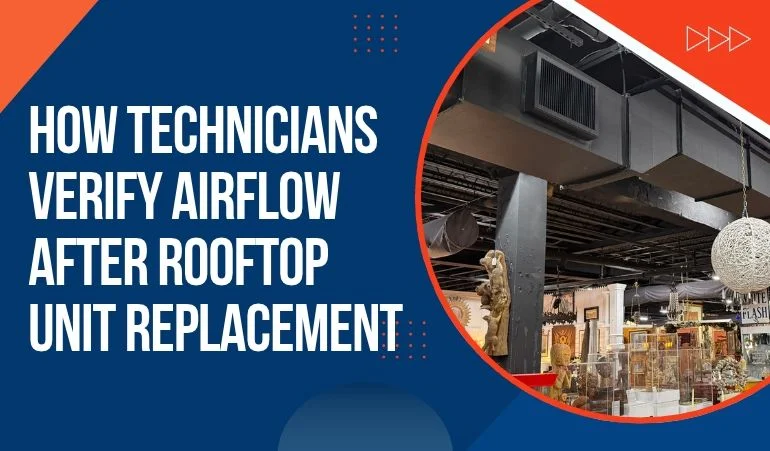
Installing a rooftop unit at a commercial facility doesn’t itself guarantee optimized airflow. Even if the equipment starts well, the restricted airflow creates multiple problems. Furthermore, if airflow remains obstructed for a longer duration of time, equipment problems, decreased efficiency, and sudden failures quickly follow.
At our project at Flaming Hot Halal Grill in Pennsylvania, we commissioned the client’s complete HVAC system for optimized ventilation and airflow using professional standards. This blog post explains the process we follow at every project. For you as a business owner, it can help you get your rooftop unit airflow optimized after the project is completed.
If you are curious about the case study, find it in "Commercial RTU Replacement at Flaming Hot Halal Grill."
Before taking airflow measurements, technicians should inspect the components responsible for moving and distributing air. This includes checking:
Supply and return ductwork
Air filters and filter installation
Supply and return grilles
Dampers and their positions
Fan and blower operation
Visible duct obstructions or damage
A blocked filter, closed damper, or disconnected duct can restrict airflow even when the rooftop unit itself is operating correctly. That’s why ignoring this step directly means you are inviting bigger repairs.
The next step is to measure how much air reaches each supply vent. Technicians use various tools and equipment for accurate findings.
Common tools include:
Balometer: Measures airflow at supply or return grilles.
Anemometer: Measures air velocity, which can help estimate airflow.
Flow hood: Captures air from an outlet to measure its volume.
These measurements are then analyzed against the building symmetry, occupants, and the requirements.
Static pressure lets the technicians understand how much resistance air encounters as it passes through the ducts. If the static pressure is too high, it means the resistance air experiences is also high. This is usually caused by dirty filters or blocked airflow. The technicians use various tools and equipment to set this pressure right before the equipment runs normally again.
Airflow measurements are only one part. The technicians also evaluate whether the conditioned air actually reaches the desired areas and if the desired temperature control is actually achieved. If the airflow is normal but the temperature is still not in the desired range as required by the space, the technicians take measures to set it correctly.
This is especially important for restaurants due to kitchen activities and a large number of customers.
Soon after taking all the measurements and evaluating components, technicians look for the problems that might be present in the system.
Possible corrections include:
Replacing restricted air filters
Adjusting accessible dampers
Correcting fan settings
Addressing duct restrictions
Checking blower and motor operation
Reviewing system configuration
The appropriate correction depends on the measurement results and equipment specifications. Technicians retest the system after making adjustments to verify the outcome.
At Flaming Hot Halal Grill, Lehigh HVAC replaced an aging 10-ton rooftop unit at a 5,000-square-foot restaurant. The previous equipment had experienced frequent breakdowns, declining efficiency, inconsistent temperature control, and compressor and refrigerant leakage concerns. After installing the replacement unit, Lehigh HVAC checked airflow, temperature control, and overall operating performance as part of the project commissioning process. These checks helped verify that the new equipment was functioning properly before the replacement project was completed.
A complete RTU replacement includes more than removing old equipment and installing a new unit. Airflow verification and commissioning help confirm that the system operates as intended.
If you need commercial HVAC services in Pennsylvania, feel free to reach out to us.