
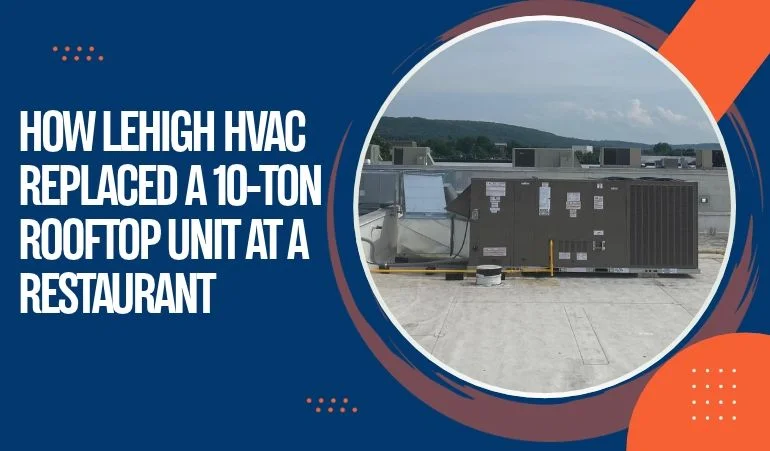
How Lehigh HVAC Replaced a 10-Ton Rooftop Unit at a Restaurant
Learn how Lehigh HVAC successfully replaced a 25-year-old 10-ton rooftop unit at Flaming Hot Halal Grill to boost energy efficiency and indoor comfort.
Read MoreContact Info
Replacing rooftop units at a commercial property involves more than mounting the unit and coordinating electrical connections. It requires hours of assessment, step-by-step installation, and then a detailed quality assurance checklist. A slight mistake at any stage can be significantly costly and lead the client’s complete investment to the drain.
Lehigh HVAC, one of the professional HVAC agencies in Pennsylvania, recently carried out four RTU installations at a commercial property, Precision Medical. The project involved replacing old, 30-year-old Trane equipment. This guide explores what goes into commercial RTU projects and how Lehigh HVAC completed the one.
Replacing one rooftop unit involves several connected tasks. A four-unit project increases the amount of equipment, installation work, and coordination required.
Here is what we considered for this project.
The condition and specifications of each existing unit.
Compatibility of replacement equipment with existing connections.
Electrical requirements and any necessary corrections.
Rooftop access and equipment removal arrangements.
Ductwork connections and modifications.
Testing and commissioning requirements.
Individual projects may have different requirements. However, here is a general approach we follow.
The first step is understanding what is currently installed. We inspect each rooftop unit rather than assuming all four have identical conditions. Important details we notice include equipment age, model information, physical condition, electrical connections, and existing ductwork arrangements. This assessment helps us identify differences that may affect replacement. For example, two units installed in the same building may have different connection requirements or serve different areas.
A new rooftop unit must work with the building's existing infrastructure or receive the necessary modifications. Electrical coordination is particularly important. That’s why we verified that the available electrical supply and connections are suitable for the replacement equipment. Identified issues were addressed as part of the planned work. The team also assessed the ductwork, as existing connections may require modification to match the new equipment and maintain suitable airflow.
Removing multiple rooftop units requires a planned approach to equipment handling and installation access. At our project on Precision Medical, we answered critical questions clearly before starting the project. Here is what we answered.
How existing equipment will be removed.
How replacement units will reach the roof.
Whether rooftop access creates logistical restrictions.
Which installation tasks depend on other work being completed.
How the building's operations may be affected during the replacement.
Installation is not complete simply because new equipment has been positioned and connected. Each replacement unit needs appropriate startup checks and commissioning. This is why we verified electrical connections, equipment operation, controls, and relevant mechanical components before handover. For projects involving several units, testing each system matters. A successful startup of one RTU does not confirm that the other three are operating correctly.
Lehigh HVAC provides commercial RTU replacement services in Pennsylvania. We plan, evaluate, install, and test the newly installed unit against ASHRAE standards for commercial HVAC services. If you have a commercial HVAC project for which you require reliable service providers, feel free to contact us for an estimate.
Learn how Lehigh HVAC successfully replaced a 25-year-old 10-ton rooftop unit at Flaming Hot Halal Grill to boost energy efficiency and indoor comfort.
Read MoreExplore how Lehigh HVAC installed four rooftop units with a combined capacity of 55 tons at a 32,000-square-foot commercial property in Allentown, PA.
Read MoreSee how Lehigh HVAC upgraded Pocono Palace Resort with three new rooftop units and Wi-Fi-integrated controls for centralized HVAC management.
Read MoreRead all the rave reviews that our satisfied customers have posted for our brilliant services