Contact Info
If you are managing a commercial property in Pennsylvania, you’d better know how complicated it is to manage temperatures across various zones. Having a separate control system for each unit, the team has to approach every unit separately, monitor changes, and make adjustments according to the space needs. This is where the need for centralized control systems comes in.
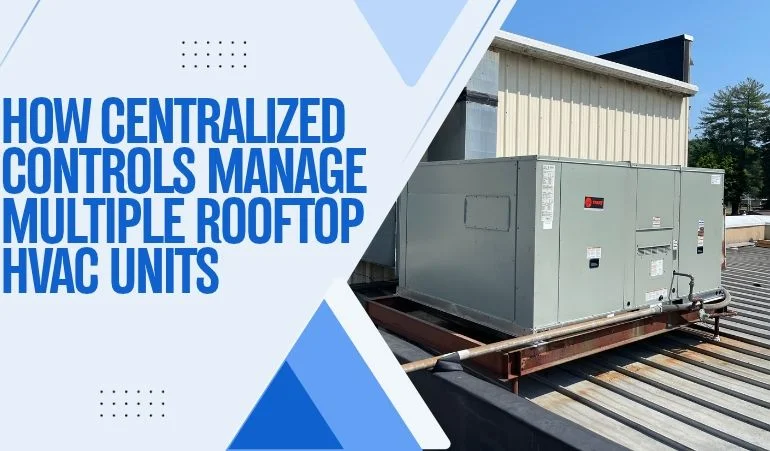
These systems integrate every single HVAC unit into a single control board from which a single person can manage the temperature, ventilation, and air conditioning of the entire space. Lehigh HVAC recently completed a project where it was required to integrate three rooftop units with a single control system. The client was Pocono Palace Resort, and the requested service was a commercial HVAC upgrade.
A central control system is a component that brings all other components together and makes the heating, cooling, and ventilation easier.
For example, a hospitality property with three rooftop units may have different heating and cooling requirements across its occupied spaces. A centralized control arrangement can make it easier for facility staff to manage these units without relying entirely on separate control interfaces. The goal isn't necessarily to make every unit operate identically. Instead, it allows users to manage different equipment through a more organized control structure.
Hospitality properties have to maintain comfortable indoor conditions while managing their daily operations. Guests may occupy different areas throughout the day, and heating and cooling requirements can change accordingly. Without an organized control arrangement, managing multiple HVAC units may require additional effort from facility staff.
Centralized controls can help address this challenge by providing:
Easier access to multiple HVAC units.
More convenient temperature adjustments.
Better coordination of operating schedules.
Centralized access to available equipment information.
Simpler everyday HVAC management.
These benefits depend on the control system's capabilities and how the connected equipment is configured.
A centralized control system works differently than a thermostat. Instead of regulating the temperature of only one area, it connects all rooftop units across the property so staff can manage them from a central place. Here is how it works.
Different areas of a commercial property may require different temperature settings. A centralized control interface can allow facility staff to adjust supported temperature settings for individual units. This is particularly useful when one area has different heating and cooling requirements from another. Rather than changing settings at separate equipment interfaces, staff can access the connected units through a shared management system.
Commercial properties do not always require the same level of heating and cooling throughout the day. Operating schedules can help align HVAC activity with occupancy patterns and business hours. For example, a facility may require different operating settings during occupied and unoccupied periods. Where supported, centralized controls allow staff to manage these schedules without configuring every unit through a separate interface.
Centralized systems may also provide access to equipment status and operating information. This helps facility staff understand whether connected units are operating and identify conditions that may require attention. Depending on the controller, available information may include operating modes, temperature readings, and system alerts.
One of the main advantages of centralized controls is the convenience of managing multiple units through a shared interface. Facility staff can access supported equipment settings without repeatedly moving between different control locations. This can make routine temperature adjustments and HVAC management easier, particularly in properties with several connected units.
Lehigh HVAC addressed the need for centralized HVAC management during its upgrade at Pocono Palace Resort in Pennsylvania.
The project involved commercial rooftop unit installation and integrating Wi-Fi-enabled controls to provide centralized management of the equipment. Rather than focusing only on replacing the existing rooftop units, the project also addressed how the resort would manage its heating and cooling equipment afterward. The connected control arrangement provided a more convenient approach to managing multiple units. If you need something similar for your commercial facility, reach out to us today.