Contact Info
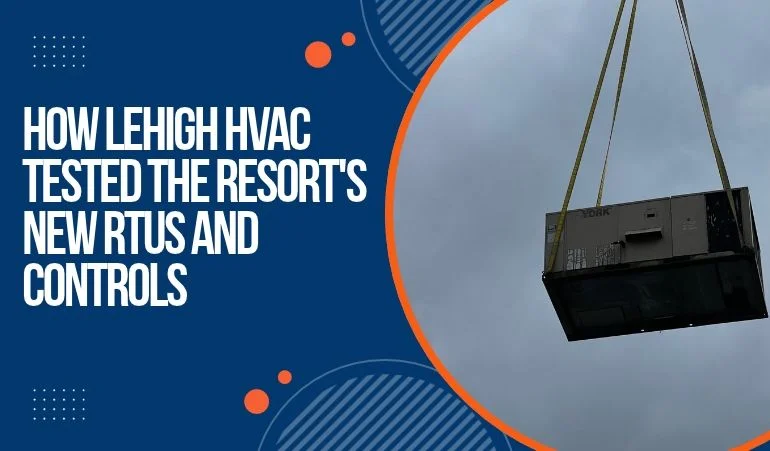
Installing commercial rooftop units is only part of an HVAC upgrade. Once the equipment is in place and the controls are connected, the system needs to be tested. This helps confirm that each unit responds correctly, the controls communicate with the equipment, and everything works together as expected.
For Pocono Palace Resort in Pennsylvania, Lehigh HVAC installed three new rooftop units and integrated Wi-Fi-enabled controls. Testing the equipment and control system was an important part of completing the project.
A newly installed rooftop unit may power on without operating as intended. Problems with connections, control settings, airflow, or communication can affect how the equipment performs.
Testing helps identify these issues before the system is handed over for regular use. It also allows the installation team to verify that individual units operate correctly and respond to their controls. For properties with multiple RTUs, this step matters even more. Each unit must perform its assigned function without creating problems for the rest of the system.
Here is what makes testing and commissioning non-negotiable for commercial properties.
Ensures equipment starts and functions properly under normal operating conditions
Verifies seamless communication between centralized controls and rooftop units
Prevents unexpected operational failures and costly downtime after handover
Optimizes airflow performance and temperature management throughout the facility
Identifies wiring errors or configuration issues before routine use
Confirms system efficiency to reduce energy consumption and operating costs
Validates overall compliance with design specifications and safety requirements
The exact checks depend on the equipment, installation, and control system. However, several areas are important when verifying a multi-unit HVAC setup.
Here is how commissioning takes place from start to finish.
Each rooftop unit needs to be checked to confirm that it starts, runs, and responds to its operating settings. The installation team can also review relevant equipment connections and operating conditions to identify anything that needs attention.
When Wi-Fi-enabled controls are integrated with multiple RTUs, the connection between the controls and equipment needs to be verified. The team should confirm that the connected units respond to their respective control inputs. If a unit does not respond as expected, its configuration and communication connections may need further inspection.
Testing should also consider how the equipment responds during operation. This includes checking relevant temperature settings, airflow, and other operating conditions according to the system's design. For a multi-unit installation, the goal is to confirm that the units operate as intended rather than treating each one as an entirely separate system.
Testing can reveal issues that are not always obvious during installation. Some examples include:
Incorrect control settings or unit configuration
Communication problems between controls and equipment
Loose or incomplete equipment connections
Unexpected operating responses
Airflow conditions that need adjustment
Finding these issues during commissioning gives the installation team a chance to address them before routine operation begins.
At Pocono Palace Resort, Lehigh HVAC installed three rooftop units and integrated Wi-Fi-enabled controls to support centralized HVAC management. After installation, the team checked the equipment control system to verify communication, system response, and coordinated operation. These checks helped confirm that the new units and controls were working together as intended.
The project brought the resort an updated rooftop HVAC system with centralized management capabilities.