Contact Info
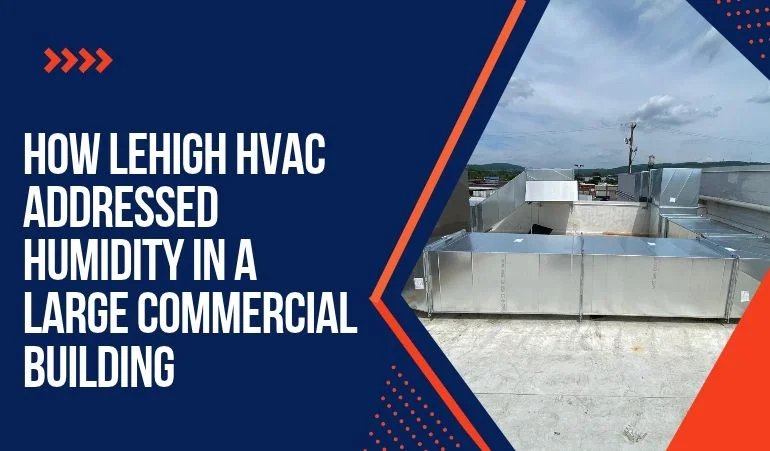
Whenever HVAC installation is discussed, humidity quickly joins the discussion. Particularly for larger commercial buildings with sizes over 30,000 square feet, tight regulation of indoor humidity becomes compulsory due to strict legal code compliance rules and tenant experience.
This is what makes humidity control essential. But the headache is that temperature regulation doesn’t automatically guarantee humidity control. No matter how efficiently your HVAC systems perform, you still have to manually inspect and find a solution to keep moisture in a controlled range.
In one of our recent projects, we encountered a similar case. Though the actual project involved installing four rooftop units at a 32,000-square-foot commercial property, along with gas piping, plumbing, and electrical connections, the client also demanded regulated humidity control. The certified Lehigh HVAC team tackled the project with expert workmanship, advanced diagnostics, and following professional standards. Let’s discuss the details in the following sections.
If you want to have a look at the actual case study, find it below.
👉 Commercial Rooftop Unit Installation at Antique Market, Allentown
Humidity has something more to do with it than how it feels. When humidity crosses 60 in a commercial space, the inside air starts feeling clammy and somewhat uncomfortable. Furthermore, fungal spores find their perfect breeding ground in high humidity levels. Air conditioning systems also struggle when they have to regulate both temperature and humidity as well.
This was about the higher humidity. Lower humidity is also not good. It makes the indoor air feel dry and uncomfortable to tenants, occupants, or customers, depending on the building. That’s all that a commercial building needs to maintain humidity in a controlled range.
Here is what to consider for better planning.
Outdoor temperature and moisture levels
Building occupancy and operating schedules
Outdoor air ventilation requirements
Indoor activities and moisture sources
Heating and cooling equipment operation
Building layout and air distribution
Considering these conditions helps technicians better plan for humidity control.
Different commercial buildings have different requirements. The regulations required to control humidity also vary with respect to occupancy, neighborhood, climate, and how the building is used. That’s what makes it essential for technicians to plan for humidity control instead of mounting the unit blindly.
At the 1471 Lehigh Street project, we assessed the site completely, understood the vapors in the air and moisture level, and considered the equipment efficiency to see how it affects the humidity. Based on the complete assessment report, the technicians took necessary measures to set the units up the right way, so they ensured all temperature regulation, humidity control, and indoor air quality as well.
Humidity management is not separate. Rather, it is coordinated with the rest of the HVAC design project.
Here is how to fit it into the overall project.
Heating and Cooling Capacity
Choose equipment that is just the right size for the building's needs. Doing so ensures the equipment itself handles humidity control as well.
Ventilation
Ensure proper ventilation for outdoor air. Doing so ensures fresh air comes inside repeatedly and removes the moisture present inside.
Air Distribution
Ensure air flows smoothly inside the ducts. It is important because if ducts are blocked, airflow is restricted and humidity may increase.
System Controls
Smart controls help manage HVAC operations. Make sure all controls are working correctly so equipment plays its part in bringing humidity to normal.
Whether your business needs humidity control for a single zone or needs a full-scale HVAC upgrade, Lehigh HVAC has the right solution for every concern. Contact us, share your project details, and obtain a free, non-obligatory estimate for a commercial rooftop installation service.