Contact Info
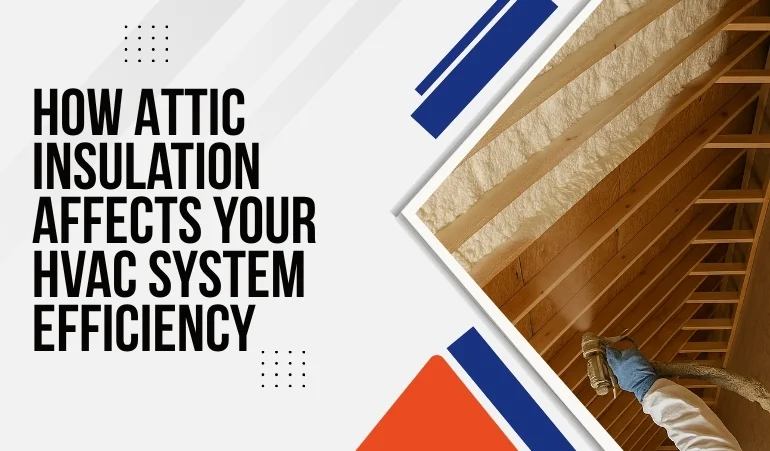
You can keep your home at the best temperature in two simple ways. First, your HVAC system generates more conditioned air (warm or cool, depending on the climate). Second, you conserve the conditioned air with a thermal barrier. The first method needs a very high-efficiency HVAC system. It will consume more energy and incur high energy bills for you. For average-income families, this option is usually not affordable. The second option needs proper insulation. It requires a one-time investment but pays it back via lower energy bills, higher HVAC performance, and excellent comfort day and night.
When it comes to home insulation, the attic plays an important role. This is because 25 to 30% of a home’s heated or cooled air escapes through the attic exclusively. Insulating the attic directly means you restrict this one-fourth of the conditioned air inside the home. This blog explores how attic insulation affects your HVAC system efficiency and helps you save on energy bills.
The attic is the most critical part in any New Jersey home. At the same time, it is the most overlooked part. It sits directly under the sun, experiencing direct sources of light and heat. The other noticeable attribute of the attic is that it directly links to the outside environment. Leaving it uninsulated means you open a pathway for your warm or cool air to the surroundings.
In summer, an open attic brings direct sunlight into the home. It means your air conditioner fights a heat source that is thousands of times greater. The result is a higher workload on the HVAC system, faster wear and tear, reduced performance, and shorter lifespan.
In winter, the problem reverses. Now, warm air lifts upward and escapes through gaps and holes in attic walls. It translates into a heat pump or a furnace that is supplying its output to the surroundings. The result is again quite similar. Reduced heating unit efficiency, poor performance, frequent repairs, and short cycling.
While working on Lehigh HVAC projects in New Jersey, we have noticed a 10 to 15% trim in annual energy costs after complete attic insulation. The results were more surprising in some larger houses. This was the result of cutting the pathway through which conditioned air inside may escape outside.
Here is how attic insulation favors your HVAC system.
This is in accordance with what we discussed in the above sections. Attic insulation blocks heat transfer between the indoor environment and surroundings. In summer, it prevents the entry of direct sunlight inside the living space. In winter, it prevents the loss of warm air to the outside. Both favor HVAC by reducing the load on it.
Attic insulation creates a stable indoor temperature. HVAC units work smoothly, operate in uniform heating or cooling cycles, and find significant time to maintain a comfortable temperature inside your living space. Whether it is a heat pump, a central air conditioner, or a gas furnace, the unit operates in normal cycles without any burden on the core components.
If the attic is not insulated, the system runs longer cycles and operates continuously. The result is frequent short cycling and components becoming warm, which can sometimes lead to complete equipment failure.
Attic insulation prevents the home from extreme temperatures. Unpredictable temperature swings due to external weather are also minimized. This, at one end, reduces equipment wear and tear. And at the other end, it prevents failure of expensive components, such as the compressor of an air conditioner or the heat exchanger of a furnace.
Attic insulation is not limited to the HVAC appliance only. It also has a positive effect on the ductwork. An insulated attic or properly covered roof deck prevents ductwork below from direct heat exposure. It reduces the chances of ductwork cracks, leaks, and material damage. The result is a longer ductwork lifespan, optimized airflow, and better air distribution inside the home.
An insulated attic is a green signal for energy efficiency. In fact, insulation is the main step in the HVAC energy optimization process. When a home is insulated, chances for heat transfer are minimized. In summer, the cool air remains inside for a long time. In winter, the same happens with warm air. A longer presence of conditioned air reduces the burden on HVAC, which then consumes less energy. It directly translates into better efficiency, more energy conservation, and lower annual energy costs.