Contact Info
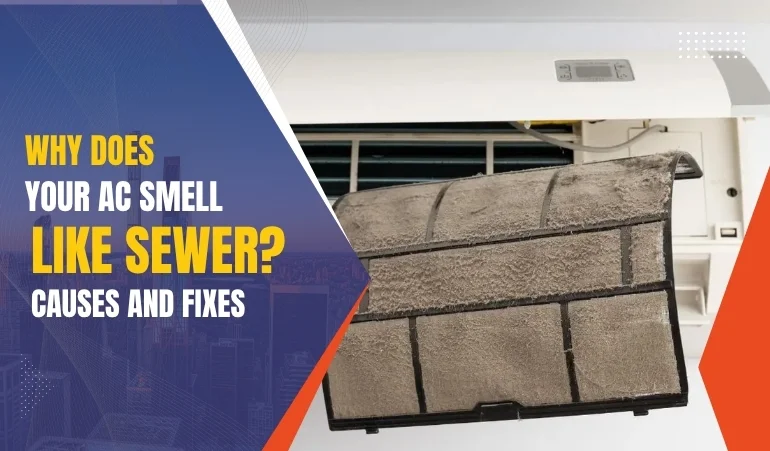
Many times, New Jersey customers come to us complaining about sewer smells from their AC unit. Some of them also show frustration that they have applied multiple AC fixes, but the issue is still the same. This is a condition that deserves a different correction strategy, which is often overlooked in various NJ areas.
Today, we will guide you on why your AC sometimes smells like sewer and what can fix this issue forever. The guide is particularly tailored to New Jersey homeowners.
Sewer smells from the AC unit are not because the AC itself produces them. Rather, these smells are due to issues in your ductwork or associated plumbing lines. The sewer gas produced in plumbing or drain lines is carried through the ducts toward your AC unit. That’s why fixing the AC or replacing its components won’t fix the primary issue. Rather, you have to identify and fix the underlying culprit.
Now, let’s understand the causes one by one and also explore how to get rid of them in each situation.
Your AC condensate drain line contains a U-shaped bend called a P-trap. This trap stays filled with water during normal conditions when your AC is operational. The water in this trap acts like a barrier and prevents movement of air from the condensate drain line towards the air handler. When you stop the AC, such as during New Jersey winters and springs, this trap gets dried out because there is no production of new water as the AC stays idle. When you start operating the AC again (usually in heating mode), this trap allows sewer gas produced in the drain line to move towards the air handler unit. From here, that air with bad smells is distributed throughout your home.
How to Fix It
Pour 1 to 2 cups of water into your AC drain trap every month when it is not in use. It will keep the trap moist and block the gas pathway.
Mold and mildew growth in condensate drain lines can create stagnant water in the drain lines. This water retention creates sewer-like gases that spread in your home. The same issue happens if there is excessive buildup in the condensate drain lines.
How to Fix It
Clean the condensate drain lines completely to remove all the buildup. You can use vinegar or an equipment-compatible cleaning agent for this purpose. Call an HVAC pro if the clogging persists.
If the drain pan is dirty and retains water, there is a chance for mold and bacterial growth. And if these colonies grow, they will spread sewer gases all across your HVAC unit, which are ultimately spread in your rooms through the air handler.
How to Fix It
Clean the drain pan regularly. Make sure there is no water retention in the pan. If there is water accumulation for a long time, clean it with suitable cleaning agents to wipe out fungal colonies entirely.
If the drain line is directly connected to the sewer without a trap, the gases can easily pass toward the air handler. The same happens if the trap is broken, damaged, or of low quality, so it is unable to block the gas pathway.
How to Fix It
Reconnect the drain line to the sewer. This time, make sure there is a P-trap in between that allows water to pass but blocks the gas pathway.
Not always; the sewer-like smells are due to condensate line components. Sometimes, the sewer line itself is the victim. If the sewage line near your HVAC line is cracked, it lets the methane gas enter the ductwork, from where this gas is carried towards the air handling unit.
How to Fix It
Call a plumber to inspect sewer lines. If there is a blockage, get it removed. If there are cracks and fractures, seal them completely. Restoring the sewer lines to their working condition will eventually eliminate those bad smells from your New Jersey home.
If you are worried about sewer-like smells from your HVAC, schedule a professional inspection service with Lehigh HVAC. Certified technicians will visit your space, inspect your HVAC and plumbing components, and fix things the right way. Schedule a consultation today.