Contact Info
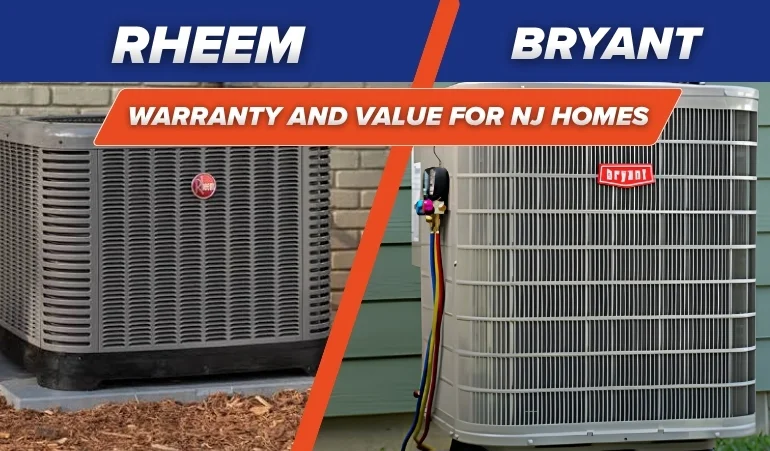
Replacing an HVAC system is a major investment. You can expect to pay $10,000 to $20,000 for complete unit installation. This is not what we can say is affordable for average families. This is why choosing the right HVAC system is more than essential. It is one of the most important decisions for home improvement and comfort. For New Jersey’s humid summers and freezing winters, Rheem and Bryant are two popular choices. Both brands manufacture high-efficiency furnaces, heat pumps, and air conditioners. However, they differ significantly in premium features, pricing, and warranty offerings.
This blog compares Rheem and Bryant in the New Jersey climate and suitability for residential properties.
|
Feature |
Rheem |
Bryant |
|
Brand Position |
Value-focused |
Premium performance |
|
Typical System Cost |
$9,000–$17,000+ |
$10,000–$19,000+ |
|
Parts Warranty |
Up to 10 years |
Up to 10 years |
|
Heat Exchanger Warranty |
20-Year to Limited-Lifetime |
20-Year to Limited-Lifetime |
|
Expected Lifespan |
15–20 years |
15–20 years |
|
Best For |
Budget-conscious homeowners |
Homeowners seeking premium comfort and efficiency |
Both Rheem and Bryant are good HVAC systems. But which one is genuinely good for your case depends on which one better handles heating and cooling for your home. Here is a comparison with respect to some important factors.
Both Rheem and Bryant are efficient in cooling your home. But how they approach cooling in your case is different from one another. Bryant is generally based on variable refrigerant flow. This is why it can better control humidity. On the other hand, Rheem can cool your home relatively faster, and this is why it might sometimes struggle with humidity. Rheem is, however, associated with mid-range value, sturdy build quality, and easier part availability.
Bryant is slightly ahead of Rheem for frosty NJ winters. This shift is due to its robust communicating control systems and superior high-end heat extraction. On the other hand, Rheem appears to be a more budget-friendly and mid-range alternative with easier modular servicing.
The choice for your home depends on your preferences. If the winter in your region is extremely cold and you need equipment that is exceptionally well in heat extraction, Bryant is a good choice. But if the winter in your region is bearable and you want a low-priced appliance, choosing Rheem could be the right fit.
This can again be correlated to what we discussed in the first section. Bryant (built by Carrier) operates on variable refrigerant cycles. It means it runs longer and slower cycles to cool the space. This is why it finds sufficient time to pull the moisture completely from the inside air, maintaining the humidity from 30 to 60%, exactly in the range that is preferred. On the other hand, Rheem, due to its fast cooling, might sometimes struggle to control the humidity.
If humidity is a bigger concern in your NJ home, choosing Bryant is a good choice. But if you want faster cooling cycles and have a separate dehumidification system, Rheem air conditioning installation could be the right fit.
For most average families in New Jersey, price is always a big concern. That’s why having a clear picture of upfront and long-term costs is also essential.
|
System Type |
Rheem |
Bryant |
|
Central AC |
$4,000–$8,500 |
$4,500–$9,500 |
|
Gas Furnace |
$3,000–$7,500 |
$3,500–$8,500 |
|
Heat Pump |
$4,500–$11,500 |
$5,000–$12,500 |
|
Repair |
Rheem |
Bryant |
|
Capacitor |
$150–$325 |
$175–$375 |
|
Blower Motor |
$300–$800 |
$350–$950 |
|
Control Board |
$350–$850 |
$400–$950 |
|
Compressor |
$1,500–$3,200 |
$1,800–$3,800 |
No brand is a winner for every case. The right choice depends on your comfort needs, budget, and preferences.
If you don’t know much about these systems, Lehigh HVAC could help you. We visit your home, understand heating and cooling needs, explain options, and help you choose the right equipment. Get in touch with us at 848-361-4707.