Contact Info
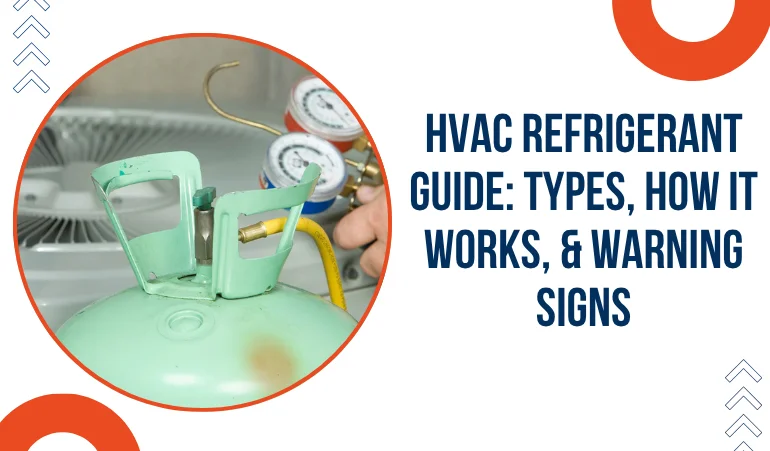
HVAC refrigerants are the most important liquids in air conditioning systems. They are responsible for heat transfer, the core process that occurs during air conditioning. From earlier times to today, HVAC refrigerants have gone through various changes. The refrigerants used a few years ago are now no longer in practice due to multiple hazards and environmental concerns associated with them. Furthermore, the handling techniques and safety measures of HVAC refrigerants have also changed.
We have put together this guide to help commercial customers in New Jersey understand what refrigerants are, how they work, and the warning signs of HVAC refrigerant issues.
HVAC refrigerants are the liquids or gaseous substances that are used in HVAC systems and carry out heat transfer. These refrigerants change their state to facilitate this heat transfer mediated by the compressor, which then expels that heat outside. Apart from HVAC refrigerants, there are many other types of refrigerants as well. It includes car refrigerant, refrigerant in home appliances, and many other units.
HVAC units that rely on a phase-change cycle to remove the heat usually use a refrigerant. It includes a central air conditioner, heat pump, and mini-split system. On the other hand, systems that only move fresh air or rely on simple heating elements rarely use a refrigerant. It includes most heating units, such as standard furnaces and boilers.
There are multiple HVAC refrigerant types. Some of them were common in New Jersey in past years but have now been completely phased out. Some are just in the process of being phased out, and some others are getting entry into the industry. Here is a brief overview of them.
This refrigerant was being used widely before 2010. Its usage stopped for new HVAC systems in 2010. In 2020, this refrigerant was completely declared phased out. The reason behind its international ban was its association with the depletion of ozone gas, which forms a protective layer over the Earth. Freon comprises chlorofluorocarbons that specifically interact with the ozone layer and lead to its depletion. The ban on this specific refrigerant was mediated by various international and national authorities in order to protect the planet.
If you want to dive deeper, explore our other guide on “Why You Need to Replace R-22 Refrigerant Systems.”
R-410A was introduced in the industry as a replacement for R-22. It was a blend of two different fluorocarbons named R-32 and R-125. The units manufactured after 2010 widely used this specific refrigerant type until it was also banned for use in new HVAC appliances in 2025.
Remember, R-410A is not yet completely phased out. It is just banned from being used with the newer HVAC units. The older units that are based on this specific refrigerant can still use it.
R-454B is the newer version of refrigerant that will replace the traditional ones very soon. It was developed after years of research carried out by HVAC companies following the strict regulations for eco-friendliness. The result, which is R-454B, contains ingredients that are both highly efficient and have the least negative impact on the environment.
This is also a relatively newer type of refrigerant. It has a good performance record in heat transfer and also lacks any significant disadvantage to the environment. R-32 is also a component of R-454B, the refrigerant we have mentioned recently. But nowadays, it is also being used separately for air conditioning purposes, especially in HVAC systems.
HVAC refrigerant flows in a closed loop of tubes, called HVAC refrigerant lines. This refrigerant changes its state from liquid to gas, followed by heat absorption from inside the room. This heat is then transferred outside via the outdoor unit, and as a result, the temperature inside returns to normal.
Multiple components and accessories are involved in this process. A failure of any of them can stop the process or reduce efficiency.
Sometimes, the HVAC refrigerant level reduces due to leakage or just because it is depleted. In such scenarios, your HVAC system displays several warning signs indicating there is something wrong with the system. Warning signs can also be due to some other issues associated with the refrigerant. Here are some of those signs mentioned.
Explore the detailed list on our other blog on “AC Refrigerant Leak Symptoms and Causes.”
Are you noticing some of the above warning signs? Refrigerant could be the culprit behind it. Contact Lehigh HVAC today for expert advice or professional repair service.