Contact Info
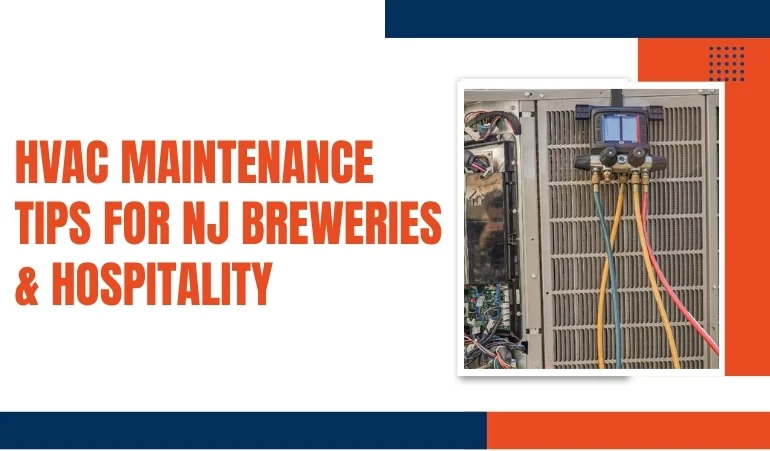
Comfort is as important in the hospitality industry as customer experience. Only if customers feel comfortable at your space do they stay and make financial decisions. This is why maintaining reliable, highly efficient HVAC operations at the hospitality site is more than essential. And this is exactly why HVAC maintenance is much more important for hospitality businesses than standard commercial facilities.
In this guide, we will explore HVAC maintenance tips for breweries and hospitality businesses in New Jersey.
Compared to residential HVAC systems, a commercial HVAC system runs for longer periods and meets more comfort demands. That’s why its maintenance should ideally be tightly regulated. A sudden failure may take a few dollars and up to some hours to get things back on track. Those few hours of downtime translate into thousands of dollars lost for major hospitality businesses. This is what makes professional maintenance non-negotiable for hospitality businesses. Apart from this, you get multiple benefits from regular HVAC maintenance.
Breweries have specific demands for HVAC. From production rooms to storage areas and staff rooms, every space demands its specialized temperature and humidity. If you fail to maintain that specific temperature and humidity, you are at risk of losing your products.
Here is what we recommend for professional maintenance.
Monitor temperature consistently in production areas and storage rooms. Keep the thermostat reading set precisely, ensuring the thermostat itself is properly calibrated. Take even slight fluctuations seriously into account as even slight temperature fluctuations can have adverse effects on your products.
Not just temperature and humidity, but air quality is also to be tightly regulated. This is where you need to keep your air filters clean. Replace air filters regularly and, if possible, use advanced HEPA filters. Or at least keep the filters above MERV 13 so they efficiently remove contaminants from the air. Additionally, check condenser and evaporator coils and keep them clean as well.
Humidity control is equally important. Excess humidity can lead to mold and mildew growth. If your brewery has a walk-in cooler or walk-in freezers, take a special focus on the humidity. Try to keep humidity under control with your HVAC system. If HVAC is not of that capacity to handle both air conditioning and humidity, consider installing a separate whole-house dehumidifier installation to combat this need.
Restaurants and hospitality businesses have their own set of challenges. Kitchens generate a high amount of heat. On the other hand, dining halls and customer service areas need continuous heat for a comfortable dining experience. You have to strike a balance and provide every zone exactly its desired temperature.
Inspect rooftop units for any visible damage or red flags. The best practices include checking yourself every month and scheduling a professional maintenance service at least every three to four months. Fix any possible culprit without delay.
Make sure the kitchen has a proper exhaust, and it remains unblocked. Maintaining proper ventilation is essential for both optimal HVAC performance and audience comfort. Beyond this, take specific measures for monitoring and improving indoor air quality. You may consider installing high-quality air filters, UV germicidal lights, and other advanced systems for air quality.
Seasonal maintenance is not just limited to superficial cleaning or filter replacement. You have to maintain everything within the right range. Here is a brief checklist to follow.
Before summer:
Before winter:
At Lehigh HVAC, we provide reliable commercial maintenance services to New Jersey businesses. From detailed inspections to careful cleaning, part replacement, lubrication, and energy optimization, we carry out everything to make your HVAC work smoothly and more efficiently. Get in touch with us at 848-361-4707 when you need commercial HVAC maintenance service.