Contact Info
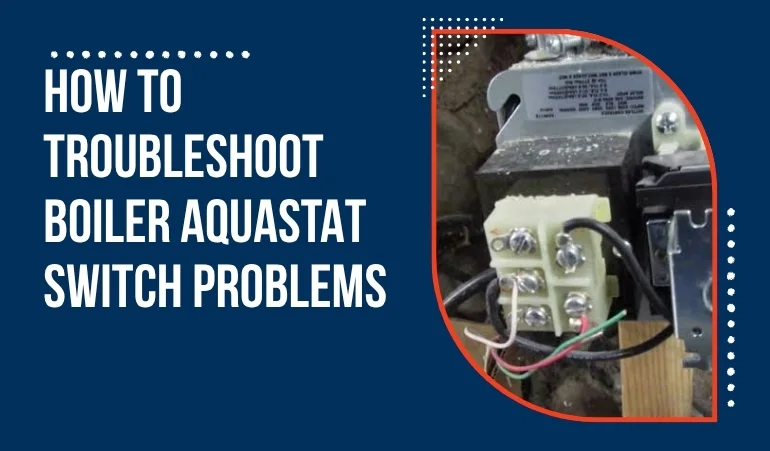
When cold weather hits Pennsylvania, closed heating systems in Allentown, Bethlehem, and Carbon County work overtime. From the ignition chamber to circulator pumps, valves, and radiators, every component plays its part to keep your home or business place comfortable. In the list of those critical components, the aquastat plays a very important role. It acts like the brain of the whole system and regulates every other component’s function.
In this blog, we will discover how to troubleshoot aquastat switch problems. We will also explore the common signs and symptoms of a faulty aquastat and how to detect it.
An aquastat plays the same role as a thermostat in air conditioning systems. It regulates the temperature of water and sends signals to various connected components according to their functions and capacities. If faulty, it can create complete discomfort in your living space. With a faulty aquastat, your living space may remain ice-cold while you crave warmth, or it may overheat the rooms to a dangerous level.
Troubleshooting can have multiple pathways, depending on the problem. Here is a generalized, step-by-step roadmap we recommend to our customers at Lehigh HVAC. Before moving towards actual troubleshooting steps, switch off the emergency electrical shut-off switch located near the boiler unit or main breaker panel.
Open the cover and check the setting of the high-limit dials. Make sure it is set between 180°F and 200°F. If it is set too low, the boiler will likely short-cycle. If it is set too high, the pressure relief valve may discharge. If your boiler uses domestic water, the setting should be between 140°F and 160°F. Inspect the limit dial for these settings, and if something is not up to the mark, fix it first before trying other solutions.
Inspect the thin capillary tube running from the aquastat to the immersion well. If this tube is bent, ruptured, kinked, or corroded, the aquastat won’t be able to sense the temperature the right way. If you identify any issues with this component, replace it and check the performance without working on other components.
Check the internal relay points that are also known as T-T for thermostat terminals. If these points are found bent, corroded, or with dark carbon buildup, they are likely nonfunctional. If these contact points are non-functional, they fail to activate the circulator pump and prevent the burner from energizing, even if the thermostat gives a heat call.
Restore the power carefully. Take a multimeter and check the power across the primary terminals as well as the low-voltage thermostat terminals. If it is not 20V across the primary line terminals and 24V across the thermostat terminals, there is likely a problem at the supply end. In this case, the issue can be solved by restoring the correct supply.
Fortunately, hydronic heating systems display warning signs before being completely non-functional. If you keep a close eye on how the system works and what’s unusual, you can easily figure out which part is actually having issues and which signs indicate what problem.
Here is what we usually notice as unusual signs while working on Lehigh HVAC projects.
No hot water coming from your taps
The boiler keeps running without ever shutting off
No heat radiating throughout your home
Boiler short cycles by turning on and off rapidly
Water temperatures fluctuate wildly between hot and cold
The boiler overheats past its safe temperature limits
High heating bills from inefficient system operation
Lehigh HVAC is a family-owned, licensed HVAC business serving Pennsylvania for over 11 years. We have an expert team, comprising certified and experienced technicians, always ready to serve the neighborhood with fast and affordable boiler repair services in PA. Whenever you experience boiler problems the next time, give us a call at 484-961-7044.