Contact Info
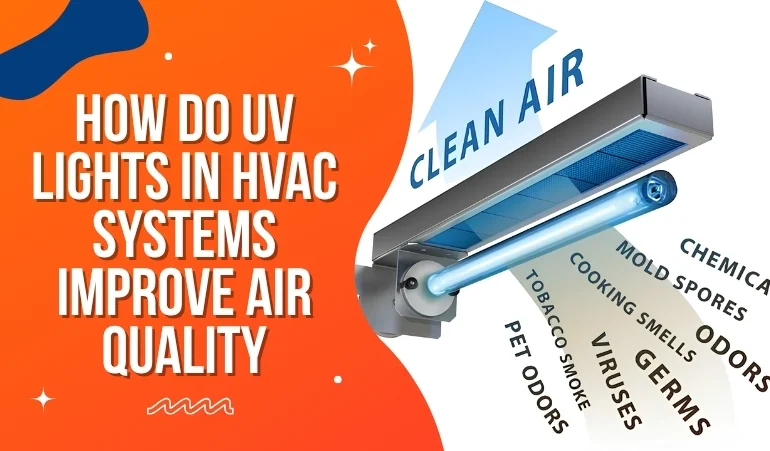
You might have heard HVAC technicians recommending the installation of UV lights in your HVAC system. Have you ever wondered why they keep repeating the same thing? There might be some benefits to this upgrade. Definitely, they are. UV lights are basically installed in HVAC systems to prevent microbial growth. And why is controlling those microbes so important? Because these microbes reduce the air quality inside, expose your loved ones to serious illnesses, and also affect the efficiency of your HVAC system. We hope you understand the basics.
Hungry for more? Let’s dive deeper and explore how installing UV-C lights in HVAC benefits you.
You might be familiar with ultraviolet radiation, which occupies the 0 nm to 400 nm range in the light spectrum. This UV light is divided into 4 layers. Out of those 4 layers, only one is used in HVAC installation. Let’s have a look at those 4 layers.
UV-A
It ranges from 400 to 315 nm. This layer is most common in light, and it is responsible for skin tanning and creating wrinkles on the skin.
UV-B
It ranges from 315 to 280 nm and is responsible for skin redness and skin cancer.
UV-C
This is the layer that is most commonly used in HVAC. It ranges from 280 to 200 nm and is most effective for germicidal control.
UV Under 200 nm
It lies below 200 nm. It produces ozone (O3) in the air.
UV-C lights are not a direct part of the HVAC system. Rather, they are integrated with components such as indoor air handlers, evaporator coils, or return air ducts. They can be used with any forced air conditioning system, such as central AC, heat pump, and furnace. The following are some benefits associated with this single addition to HVAC appliances.
Mold and mildew are headaches for almost every commercial HVAC customer in Pennsylvania. They create musty odors in business places, reduce HVAC efficiency, and create several health concerns. UV-C lights find their best application in controlling these uninvited guests. Dampness near your HVAC units, especially the condensate drain lines, provides the perfect breeding ground for fungal species. When UV-C lights shine on these surfaces, they restrict mold colonies from multiplying. As a result, you get rid of the following:
Improved indoor air quality is, in fact, a secondary benefit of microbial removal. You might be thinking that I have already installed a high-quality air filter, so why do I need an extra installation for air quality? You are right here, but the fact is that air filters alone can’t guarantee healthy air quality. If you have high-quality filters, they can trap even the smallest particles. Well. But the issue is that many biological bodies, spores, and pathogens still manage to pass the filtration process.
UV-C lights then do the job that filters can’t do. They kill those biological bodies inside your space and keep the air quality inside healthy. That’s why Lehigh HVAC technicians always recommend using both high-quality air filters and UV-C lights simultaneously to enjoy the best outcome.
As we mentioned earlier, UV lights are not just good for your health; they are beneficial for your equipment’s health, too. Mold and mildew can build a thick biofilm in various HVAC components. This film can reduce airflow, which directly puts pressure on core HVAC components such as the compressor. When this airflow obstruction remains for longer periods, it significantly decreases HVAC efficiency. In some extreme cases, it can lead to complete HVAC failure, leaving you stranded in heat or cold.
Installing a UV light ensures there is reduced microbial growth and reduced chances of airflow obstruction, so you enjoy better comfort and optimal HVAC performance.
Installing a UV light in an HVAC system can be a smart decision. It prevents microbial growth, keeps the indoor air healthy, and leaves a positive impact on your HVAC, too. Contact Lehigh HVAC for UV-C light installation anywhere in Pennsylvania. No worries if you are out of budget right now; you can always pay in installments with 0% financing. Grab your free estimate today at 484-961-7044.