Contact Info
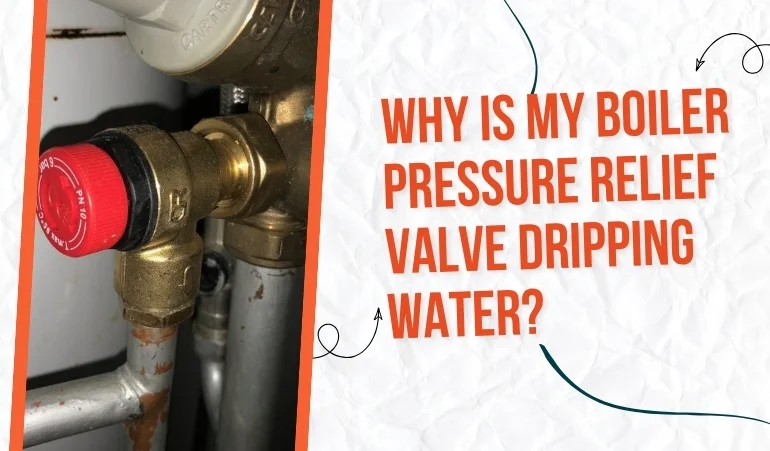
When homeowners see water dripping from their boiler, they often assume it's a bigger problem. Some call for emergency help. Some schedule a replacement service blindly. Others rush to replace the relief valve. The actual problem is, however, pretty simple in 90% of cases. A few minutes of careful diagnosis and the right troubleshooting strategy can fix it completely. This blog explains why your boiler relief valve sometimes drips water and how to fix it. The guide is specifically helpful for homeowners and facility managers in Pennsylvania.
A boiler relief valve is a safety device. It controls the boiler pressure and prevents major damage to the system. Here is how it works.
In normal circumstances, the ignition process warms the water. This warm water takes up more volume and exerts more pressure on the surrounding components. If the expansion tank is working and has the capacity, it absorbs extra volume without increasing gauge pressure. But if the expansion tank is failing or the pressure is too high, boiler pressure exceeds its safe limit, which is usually 30 PSI. This increased pressure triggers the relief valve, which opens automatically and releases extra water. This water escape brings the water volume and boiler pressure back to normal, and the system then starts working normally.
From its working mechanism, you can understand that a relief valve leaks water when it detects higher pressure. It means there is nothing wrong with the valve itself. Rather, some other culprit is increasing the pressure, and the relief valve is showing a warning sign to fix that issue. In such a situation, replacing the valve is not the solution to the problem. Rather, identifying the cause that increases pressure and fixing it is the right step.
The causes can be diverse. From faulty components to negligence, multiple things can cause this relief valve to leak.
Every boiler has a small tank known as an expansion tank. It is half filled with water and half filled with air. When water heats and expands, this tank works as a cushion and absorbs extra volume of water. In this way, it prevents pressure from being too high. But if the expansion tank is waterlogged, this extra water volume directly hits components and increases the gauge reading. As a result, the relief valve leaks water.
The solution to this problem is expansion tank replacement. It usually costs $300 to $500+ and a few labor hours.
Boilers are closed systems. The water enters through the fill valve and remains in the system until you remove the water yourself or leakage happens. If somehow the fill valve is stuck open, water continuously enters the system with no escape at that frequency. Or if someone manually adds too much water to the system, it contributes to increased pressure and results in the relief valve leaking.
The solution to this is to release the excess water. If you do it yourself, you spend $0. If you hire a technician, you have to spend $100 to $250 for a service.
An auto-fill valve provides the entryway through which water enters the system. It opens only when the pressure drops below normal. If this pressure-reducing valve is faulty and remains stuck in the open position, it continuously adds water to the system despite no need. The added water increases water volume, puts strain on the components, and increases gauge pressure readings. The result is the same: the relief valve leaks water to bring pressure back to normal.
Not all relief valve drips are due to other faulty components. Sometimes, the valve is faulty itself. This is the condition in which pressure is normal; the readings on the pressure gauge are also normal, but the valve is still dripping. It happens when the valve is defective, corroded, or just worn out. Aging or mechanical damage can also be the reason behind its failure. If the relief valve is faulty, it drips water and drops boiler pressure.
This issue is fixed by replacing the relief valve, which may cost $150 to $300, depending on the system.
Though not an emergency, a leaking relief valve can be uncomfortable for your family. If neglected, it translates into major problems, reduced efficiency, and component failures. So, the best strategy is to call Lehigh HVAC immediately after you notice this problem. We will arrive fast, diagnose the system, and fix it the right way. Give us a call at 484-961-7044 for further discussion.