Contact Info
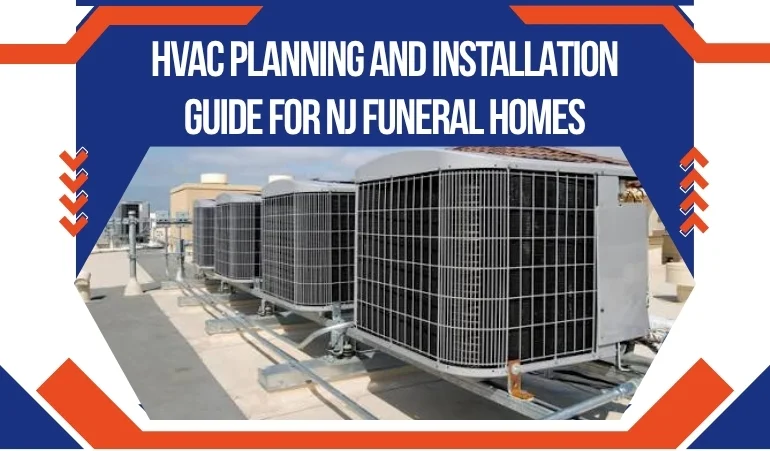
Funeral homes have HVAC requirements that differ greatly from standard commercial properties. As a funeral home manager, you have to think beyond just temperature control. You also have to focus on quiet HVAC operation, air quality, and a completely stable thermal environment for grieving families. Some specialized rooms, such as cremation sections, continuously release heat, and that’s where they need an extraordinarily performing HVAC to maintain comfort.
New Jersey weather further worsens the situation. It poses unique HVAC challenges in every season. Summers are hot and humid. Winters are extremely chilly with frequent snowstorms. Shoulder seasons are also not quite comfortable. They can be unpredictable with frequent heat and cold snaps. All these problems have a single solution: specialized HVAC planning and installation for NJ funeral homes. And this article covers all that stuff.
Funeral homes need specialized HVAC. It must maintain comfort, healthy indoor air, and discretion, as well.
Here are the key considerations:
HVAC planning starts long before the installation. It usually starts with a site survey, equipment selection, site preparation, and then the actual installation process. Here is a step-by-step approach we follow at Lehigh HVAC.
Different rooms in a funeral home have different occupancy levels and structural styles. The comfort needs also vary from section to section. Visiting areas, preparation lounges, and family rooms all demand different temperature, humidity, and air quality levels.
A professional contractor usually starts with designing and planning the HVAC for your specific building. It covers load calculation, ductwork inspection and design, and preparing the space for system mounting.
A high-efficiency HVAC system reduces operating costs, provides uninterrupted comfort, and also keeps indoor air quality at healthy levels. We recommend NJ customers choose an air conditioner with an SEER2 rating of 14 or above for summer cooling. Heat pumps and variable-speed air conditioners have also emerged as a good alternative to central ACs. For heating in winter, choosing a high-efficiency gas furnace is a good choice in NJ. But make sure you choose an AFUE furnace above 90%, so you prevent spiking energy bills.
No matter how energy-efficient a unit you choose, if it is not installed accurately, it won’t be able to work smoothly. This is where installation and installers matter. Make sure the contractor you hire is knowledgeable, certified, and experienced. Beyond this, we recommend choosing a local technician because they better understand the climate demands in your area and how to meet them. Understanding the user manual of the equipment before installation is also recommended to prevent accidental equipment damage.
Once installation is complete, technicians perform commissioning. This is the stage where all HVAC components are inspected, checked, and verified. Only if all parts are working as intended do technicians move towards walking you through how to use the newly installed system.
Installing the unit accurately is only half the battle. To maintain reliable and efficient performance, you need regular HVAC maintenance done right by professionals. And for funeral facilities in New Jersey, this maintenance is something more than just air filter replacement or superficial cleaning. It should include:
This maintenance should ideally be scheduled twice every year.
Lehigh HVAC is a professional company serving New Jersey with speedy and dependable HVAC services. We clearly know how to keep funeral homes comfortable every season, every day. Give us a call if you want reliable HVAC installation, repair, or maintenance service. Call us at 848-361-4707 for further consultation.