Contact Info
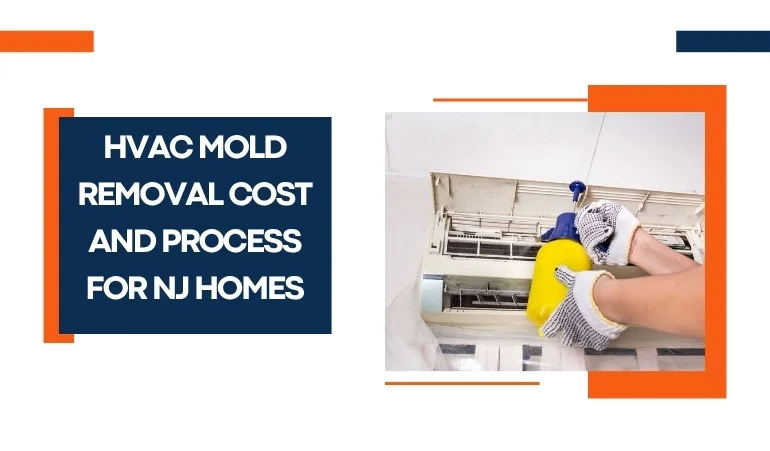
When mold takes hold of an HVAC system, it is both an air quality and a mechanical issue at the same time. It spreads fungal spores in the air, declines system efficiency, and exposes your family members to serious health concerns. The even worse thing is that standard cleaning practices, soaping, or mold removal techniques usually fall flat in this case. A specialized technique executed correctly by an HVAC cleaning expert yields satisfactory results.
If you are a homeowner in New Jersey struggling with uncontrolled HVAC mold growth, this blog is for you. It tells you the 2026 price trends and how the process works step-by-step.
In New Jersey, HVAC occupied by mold may cost you $500 to $5,000+. It is not just for cleaning. Cleaning usually costs a few hundred dollars. It is the cost for complete restoration. Sometimes, mold growth is so persistent, and the damage has already been intense, so you have to replace some expensive components.
Here are a few cost figures to help you plan your budget smartly.
|
HVAC Service Scope |
Average Cost |
What the Service Covers |
|
System Diagnostics & Inspection |
$150 – $300 |
Checking static pressure, identifying moisture leaks, and inspecting internal coils. |
|
Evaporator Coil & Blower Deep Clean |
$400 – $1,200 |
Chemical degreasing of aluminum fins, pull-and-clean service, and blower wheel scraping. |
|
Air Handler & Drain Pan Restoration |
$300 – $800 |
Clearing condensate line clogs, pan sanitization, and setting proper drain pitch. |
|
Full HVAC Air Duct Mechanical Cleaning |
$1,000 – $3,000 |
Agitation brushing and heavy-duty HEPA extraction across supply and return trunks. |
|
Flex Duct Replacement |
$2,000 – $5,000+ |
Complete removal and replacement of contaminated or saturated flexible ductwork. |
Not every HVAC mold removal service is the same. And that’s why the costs for two systems and two services should not be the same. It always depends on the extent of growth, access point, and the labor rates in your local region.
Here is what affects your final invoice.
The more complex the job, the more it will cost. This is the general rule for all mechanical services, and the same applies to HVAC mold removal as well. If your HVAC is somewhere in a tight crawlspace, in an attic with no direct access, or somewhere in an unconditioned basement, it is hard for technicians to clean it directly. It takes hours to make a pathway, cut supplies, and get direct access to actual fungal colonies. These extra labor hours add something to the final invoice.
HVAC metal ducts are usually insulated with fiberglass for sound attenuation. This insulation gets wear and tear over time due to metal fatigue, corrosion, and moisture damage. It creates trouble during cleaning, and the ultimate solution is replacing that damaged insulation before technicians can actually proceed with duct cleaning. It adds extra labor hours, extra job complexity, and a larger figure on the final invoice.
HVAC systems with multiple zones or heavy tonnage need more time and extra labor for complete mold removal. Extra resources and equipment might also be required for complete access to the compromised areas. This additional complexity and load directly increase the costs.
Cleaning an HVAC with mold growth requires a meticulous strategy. Technicians have to remove those stubborn stains while preserving the expensive components. Here is an ideal step-by-step approach to accomplish things smoothly.
Technicians start by identifying the culprit before picking up brushes and cleaning agents. They check which parts have the highest moisture. Evaporator coil, condensate drain pans, drain lines, blower motor assembly, and main supply plenum: everything is checked.
Before starting the process, the technician turns the system off at the thermostat and circuit breaker level. The next step is to separate the air handler from the ducts. This is required to prevent harmful agents from spreading to living areas while technicians are working.
Technicians clean the evaporator coil and drain pan one by one. Using gentle brushes, extensions, and small cleaning tools is required at this step. They also use a non-acidic HCL cleaning agent for effective cleaning to remove any residual buildup in delicate aluminum fins.
Technicians scrub the interior walls with specialized brushes, whips, and other cleaning equipment. HEPA extraction creates negative pressure, and high-volume suction pulls the loose buildup. The residue collected from the ducts passes through attached channels for waste collection.
Once components are clean as intended, technicians verify that they work as intended. They ensure every component works accurately and maintains proper airflow. And as the last part, they take some steps to prevent moisture issues for the future. It includes installing a whole-house dehumidifier or adding UV-C germicidal lights, depending on the requirements.
Contact Lehigh HVAC for expert solutions at affordable prices, anywhere in New Jersey.