Contact Info
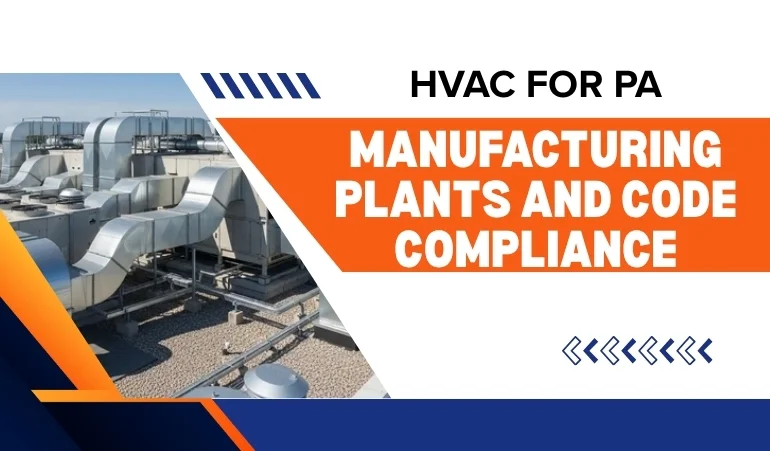
HVAC demands for manufacturing facilities go beyond basics. HVAC is not just for staff comfort here. It has to handle the heat generated by heavy machinery, dust and particles in the air, and contamination produced during the production process. It has to maintain a comfortable temperature, proper ventilation, healthy indoor air quality, and humidity in control.
Pennsylvania weather adds an extra layer of complexity. Weather is unpredictable. From summer humidity to snowstorms in winter and unpredictable weather in shoulder seasons, everything fights against your HVAC. The solution to all these concerns is a specialized HVAC approach designed specifically for this type of business.
Manufacturing facilities are different from retail stores, shopping malls, or small corporate offices. The biggest issue is that such facilities produce massive amounts of heat every day. Furthermore, the production processes often generate fumes, dust particles, and contaminants. If not filtered immediately, such particles are not filtered by HVAC.
Here are some top HVAC priorities for manufacturing units.
Due to the unique environment, operational workflow, and production process, HVAC units at manufacturing setups experience challenges. Here are some of those that we have encountered at Lehigh HVAC.
Different facilities need different HVAC systems depending on the needs. Brand, equipment model, size, and efficiency—everything is according to what you need. The table below summarizes different HVAC units and their best usage.
|
HVAC System |
Best For |
Key Advantage |
Consideration |
|
Medium to large facilit ies |
Heating and cooling in one package |
Roof access required |
|
|
VRF Systems |
Multi-zone facilities |
Excellent energy efficiency |
Higher upfront investment |
|
Make-Up Air Units |
Plants with exhaust systems |
Replaces exhausted air |
Must be properly balanced |
|
Chiller Systems |
Large industrial facilities |
Precise temperature control |
Complex installation |
|
Offices and small production areas |
Cost-effective |
Limited capacity |
|
|
Packaged Units |
Warehouses and light manufacturing |
Easy installation |
Less zoning flexibility |
Commercial HVAC installation in Pennsylvania must comply with the Uniform Construction Code (UCC). For this purpose, you have to obtain a permit, schedule an inspection, and get it approved before you proceed toward actual installation. Here are the requirements and why they matter.
|
Requirement |
Why It Matters |
|
Mechanical Permits |
Required for most new installations and major replacements |
|
Ventilation Requirements |
Maintain healthy indoor air quality |
|
Exhaust Systems |
Safely remove process heat, dust, and fumes |
|
Fire & Smoke Dampers |
Help limit fire and smoke spread through ductwork |
|
Energy Efficiency |
Meet current energy conservation standards |
|
Equipment Clearances |
Ensure safe maintenance and operation |
|
Final Inspection |
Verify code compliance before operation |
HVAC planning and design for manufacturing plants doesn’t end at good temperature control and code mechanical permits. Indoor air quality is also a concern. Regulatory authorities now make it mandatory for every commercial facility to maintain strict air quality inside.
Here is what your HVAC should help with
Commercial HVAC installation is a complex job, requiring a meticulous approach. Choosing the right contractor is essential to accomplish the project the right way. Take a look at the contractor's profile, license, certification, and success rate before saying yes to the quote. Hiring the right, skilled contractor ensures you get your equipment installed fast, without any interruption and accidental damage.
For Pennsylvania customers, Lehigh HVAC is a one-stop solution to all HVAC services. We understand the manufacturing unit demands on HVAC and how to meet those requirements at a professional level. Feel free to discuss your next project with our expert team.