Contact Info
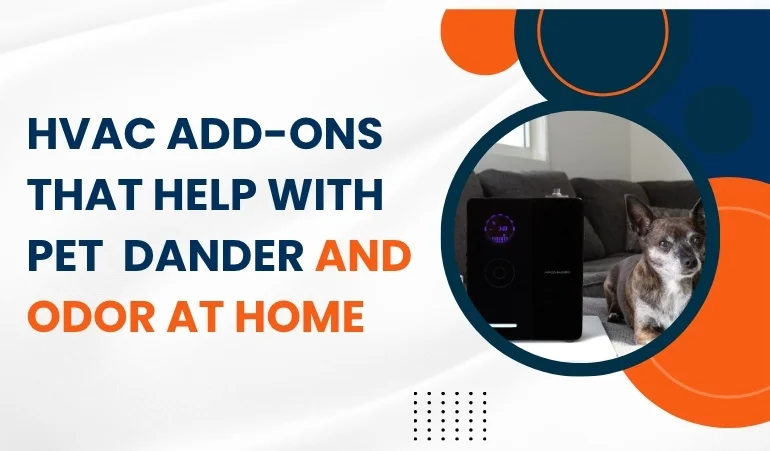
HVAC is not just limited to heating and cooling. It is expected to keep our home at a comfortable temperature, normal humidity, and good air quality. But a standard HVAC system usually struggles to ensure all these desired outcomes. This is where the need for HVAC add-ons comes in. Different HVAC systems demand different additional accessories for efficient air control. Some demand good air filters, and you get purified, clean air. Others demand dozens of additional supplies and still struggle.
This blog explores HVAC add-ons that help with pet dander, bad odors, and poor indoor air quality. Let’s first understand why pet dander is a problem.
If you have a soft heart for domestic animals and pets, you must be maintaining proper hygiene practices. But cleaning it with soap or shampoo is not sufficient. The fact is that pet dander contains several microscopic-level contaminants that mix up with the indoor air. They circulate with the help of HVAC and are distributed across every living area. Now the risk is that someone in your family might inhale them unintentionally. And if this happens, you are at risk of experiencing severe health concerns.
The same is true for odors due to pet dander. And this is what makes it an issue beyond just a cleaning practice. And this is what makes HVAC add-ons compulsory.
This is the first layer of defense for small particles and uninvited guests. HVAC air filters should ideally capture small particles before they enter the indoor environment. At Lehigh HVAC, we recommend our clients use air filters with MERV 14+; they ensure no microbial agents bypass this layer. Apart from this, timely replacement of filters is also essential. And here we recommend monthly inspection. Whenever you notice visible buildup, poor air quality, or allergic symptoms in your family members, replace filters immediately. If filters are washable and reusable, make sure they are kept clean.
This is a relatively modern air filtration technology. HEPA filters can efficiently capture small particles that a random good MERV air filter might not trap. This is because HEPA filters are based on advanced technology. If you want to keep air quality up to the mark and eliminate pet dander and odors from your home, these filters can be an excellent choice. But the issue is that HEPA filters can only be used in specialized HVAC systems, not random ones. If your HVAC supports them, definitely choose HEPA filters.
This is another advanced technology for microparticle removal up to 0.001 microns. The mechanism is pretty simple. They polarize the particle, giving it a specific charge. After this, these particles are attracted and captured at internal collection plates due to opposite charges. This process ensures particles that bypass standard filters are captured here.
This is a technology based on the ultraviolet rays that fall in the specific spectrum of light waves. The UV-C lights are installed near the indoor evaporator coils. Their primary function is to sterilize bacteria, mold, and odor-causing particles.
All the above accessories and filters we mentioned are good at capturing pathogens and smaller particles. But none of them can capture small contaminants at a molecular level. This is achieved via carbon filters. This strategy is especially good when you suspect volatile organic compounds (VOCs) in your home.
Pet dander and odors are an issue beyond hygiene. When left overlooked, they can put your loved family members at risk of getting serious illnesses. The realistic solution lies in eliminating these odors, not omitting the love for pets. By integrating HVAC with MERV 14+ or HEPA filters, UV-C germicidal lights, carbon filters, and electronic air cleaners ensure your air stays fresh and your loved ones stay healthy.
Contact Lehigh HVAC for expert solutions.