Contact Info
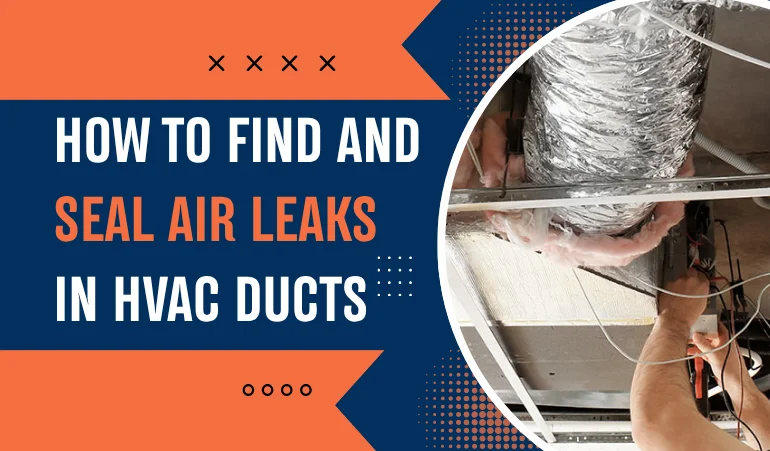
Air duct leaks cause big trouble for a home's heating and cooling. The conditioned air escapes through these leaks, leaving the home at a desired temperature. Not limited to this. Air duct leaks are also responsible for poor indoor air quality, fast wear and tear to the equipment, reduced efficiency, and higher energy bills. That's why it's essential to identify leaks and seal them immediately.
This blog will walk you through a step-by-step plan of how to identify leaks in HVAC air ducts and how you can seal them.
Air duct leaks are cracks, gaps, fissures, or holes in HVAC ducts from where conditioned air can escape. This conditioned air mixes with non-conditioned air outside and is wasted before it reaches the home where it is desired. According to Energy Star, leaks waste approximately 20% to 30% of a home's conditioned air.
Air leaks do something more than just waste energy. They increase wear and tear on the equipment and cause a spike in energy bills. Decreased airflow puts an additional burden on your HVAC components and leads to internal component failure. The open holes in the ducts allow outside allergens and pollutants to find their way inside your house.
Multiple tests are used to identify air passageways in HVAC ducts. The scope of methods ranges from simple and visual to equipment-based. The following are some of those mentioned.
This is the first step when identifying air leaks in ducts. Check all the visible parts of your ducts. Inspect them in basements, attics, crawl spaces, and wherever you have easy access. If you notice signs of black or dark gray spots of dust around ducts, it means your conditioned air escapes through this hole. Furthermore, you may notice frayed, missing, or torn-out pieces of the insulation on the ducts themselves. There may also be loose connections present in the duct network, signaling an air leak.
Turn your thermostat on and check the output of the blower motor fan. Make sure the fan is blowing conditioned air at its full potential. You can also walk yourself through the duct path and run your hand near the joints, elbows, and connections. A higher-than-normal pressure means that a particular duct portion is leaking air.
If the air leak is too small, you can confirm it via a smoke or incense test. Turn the system on and run it at its full potential. Now, hold the smoke source near the region where the leak is suspected. If you notice smoke is sucked or pushed out of the duct, you have identified the leak. The same is true if the smoke is dispersed right after the ducts.
This is a somewhat advanced level of leak detection. A thermal or infrared camera is used, which detects the temperature variations. This temperature variation then decides whether leaks are present or not. There are also multiple other leak detection methods used at complex projects or commercial sites, mainly. Some of them include mass spectrometry, ultrasonic technology, and infrared analyzers.
Follow the process below to seal leaks in HVAC ducts.
Before beginning any inspection or repair, turn the system off at the circuit breaker level. It will prevent conditioned air from blowing when you are actually fixing the issue or sealing the leaks.
Use any of the aforementioned methods to detect leaks. Use a flashlight and inspect visually. You can see large leaks via this method easily. For minor leaks, you can use some of the advanced detection methods.
Clean the surface where the leak is present. Use a clean towel and a detergent for this purpose. Make sure the surface is completely clean, dry, and free from dust before you apply any sealant or do any further steps to seal the leak. Learn about the duct cleaning costs in our other blog on "HVAC Duct Cleaning Cost in New Jersey: 2026 Price Guide."
Use a thin layer of water-based mastic sealant to seal the leaks. If leaks are larger, combine them with a fiberglass mass for structural reinforcement. You can also use UL-approved aluminum foil to seal minor leaks. Press the tape firmly on the surface so that it sticks firmly.
After sealing, insulate the exposed areas again. You can use R-6 or R-8 fiberglass insulation for this purpose. The insulation will add a further protective layer around your HVAC ducts and prevent any escape of the conditioned air from the leaks.
The experts at Lehigh HVAC recommend the following tips and best practices to prevent HVAC air leaks.
Lehigh HVAC provides reliable duct sealing services in New Jersey. Contact us today at 848-361-4707 to schedule a service or get a custom quote.