Contact Info
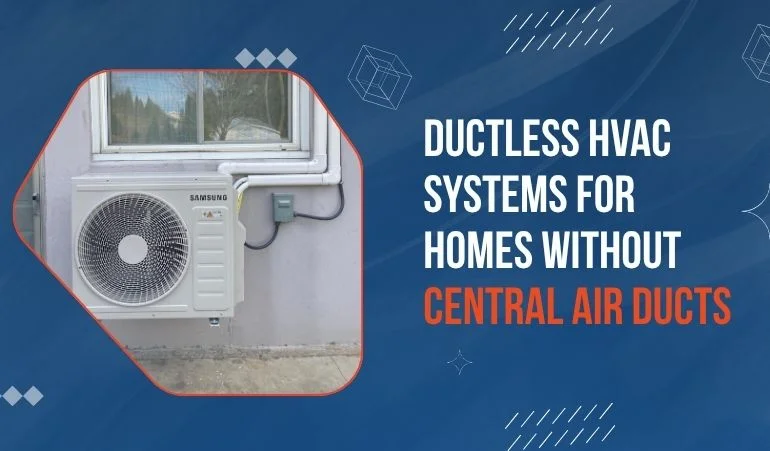
Though most New Jersey homes have ductwork, there are still some boroughs, cities, and towns with older homes that lack ductwork. Such houses present problems for HVAC additions. As there is no ductwork at all or it is not connected to some rooms, such areas are deprived of comfort. While many of these homeowners think demolishing and rebuilding the home is the solution, this is not the truth. For HVAC at least, you should not demolish your home. There are many other solutions to maintain comfort, and ductless systems offer one of those.
In this blog post, we will discuss the basics of ductless HVAC systems, including an introduction, how they work, applications, and a comparison with standard HVAC systems.
As the name suggests, ductless HVAC systems are standalone units that don’t rely on the duct network to cool or warm a home. Really? Then how do they work? This is what we hear every time we introduce ductless systems to worried New Jersey homeowners. The answer is pretty simple. Ductless systems rely on refrigerant and directly transfer heat inside or outside the home, depending on the requirements.
Soon after homeowners get interested in this relatively innovative HVAC technology, they inquire about the options available. While there are so many brands and manufacturing companies working on ductless technology, there are two main types popular in New Jersey.
A single-zone mini-split system connects one indoor air handler to one outdoor unit. The systems are designed to keep very confined homes' narrow spaces comfortable. This is also a great option to complement comfort in spaces when you have added a new room in an existing home.
In contrast to single-zone systems, multi-zone mini-split systems connect multiple indoor units to a single outdoor unit. The result is that the outdoor unit stays the same, but comfort is delivered to various rooms according to their demands. These systems are specifically good for space-saving designs and where the requirement is to keep various rooms in a house at various temperatures.
Here is how you can differentiate between these two popular units:
Feature |
Single-Zone Mini-Split |
Multi-Zone Mini-Split |
|
Indoor Units |
One |
Multiple |
|
Outdoor Units |
One |
One |
|
Best For |
One room or space |
Multiple rooms |
|
Temperature Control |
One zone |
Separate zones |
|
Installation |
Simpler |
More involved |
|
Space Saving |
Good |
Excellent |
|
Common Use |
Room additions |
Whole-home comfort |
As we have discussed, a ductless HVAC system moves heat between indoor and outdoor through the refrigerant. The fluid running in this refrigerant line changes its form from liquid to vapors and then back to liquid during this process, accompanying heat transfer. Here is the process in a few lines.
The indoor unit absorbs heat from your room
Refrigerant carries that heat to the outdoor unit
The outdoor unit releases heat outside the home
Refrigerant returns indoors to repeat the cycle
In heating mode, the process works in reverse
Ductless systems can be used anywhere and everywhere. They are best used for older homes in New Jersey that lack precise ductwork. Here is what makes them perfect for such residential buildings.
Ductless systems work without adding traditional air ducts
Installation requires less structural work inside the home
Each room can have its own temperature setting
They work well for older homes without ductwork
They can easily serve new home additions
They take up less space than traditional ductwork
Multi-zone systems can heat or cool several rooms
They provide efficient comfort where you need it
Lehigh HVAC specializes in timely, careful, and expert ductless mini-split installation in New Jersey. With us as your comfort partner, only experienced and licensed technicians handle your project. We are accountable for any errors and omissions during the project. Contact us at 848-361-4707 for service bookings.