Contact Info
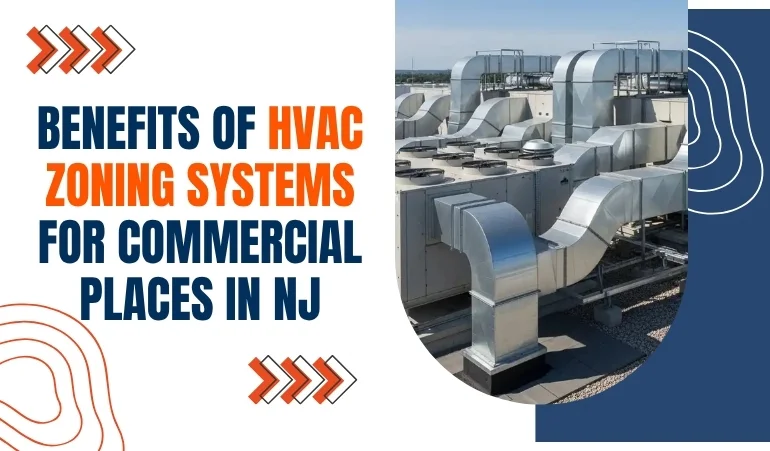
Managing a commercial facility in New Jersey, we all know that a one-size-fits-all approach is never good. You must have different rooms dedicated to different purposes, including meeting rooms, kitchens, storage areas, parking, waiting areas, etc. As every room serves a different purpose, it demands a different temperature. For example, you have to provide the most comfortable environment in the meeting and staff rooms. The temperature in the kitchen and storeroom can be kept slightly less regulated. This is why you need a zoning system for your commercial setup in New Jersey.
In this blog, we will explore the benefits of HVAC zoning for commercial facilities in New Jersey.
HVAC zoning is basically a process of splitting a space into distinct zones. Instead of distributing the conditioned air evenly throughout the business place, you divide it into multiple parts. Then you spread conditioned air according to your own choice in various zones. The rooms with direct client meetings, staff work, or where your customers spend time get the most comfortable temperature. Temperature is, however, slightly less regulated in low-traffic areas such as parking, kitchens, and storage areas.
HVAC zoning is achieved by dividing your space into various, independently managed zones. You may consider an example of a separate AC or a heat pump in each zone, which is dedicated to that zone exclusively. Here are some core components used in HVAC zoning setups.
Multiple Thermostats
You place a dedicated thermostat in each zone. This thermostat monitors temperature and sends a signal to the control panel to regulate temperature control accordingly.
Central Control Panel
It is just like the brain of an HVAC system. It receives input signals from every thermostat and regulates the distribution of conditioned air according to requirements.
Motorized Zone Dampers
These are automated gates and valves that are installed in the ductwork pathway. They regulate how much air to let into each specific zone.
Zoning systems have benefits for more than you think. Let’s shed light on some of them.r
Imagine it is July in New Jersey and the temperature is just exceeding 80°F. You want to keep it below 70°F, but your air conditioner has a lower SEER rating and is of small size. It just can’t handle the aggressive cooling in the entire building. So what would you do to maintain comfort at desired levels without replacing the AC system?
The zoning system is the perfect solution for this concern. You can slightly raise the temperature of less-trafficked areas while keeping the high-traffic areas at the optimized temperature. In this way, you reduce the burden on your HVAC system without compromising the comfort of your staff or customers.
This is just the secondary benefit of what we discussed above. When you deprive the unused areas, such as basements and crawl spaces, of the conditioned air, your HVAC system consumes less energy without reducing the comfort. The result? You save energy and save on energy bills each month.
When you decide clearly which specific zone will receive how much conditioned air, there is less pressure on the HVAC system. All components work smoothly, airflow is balanced, and the chances for emergency breakdowns or accidental failures are minimized. As a result, you spend less on HVAC repairs.
Zoning allows you to balance HVAC capacity with the output you need. You look at your system, its capacity, and specifications. You get a clear idea of how much space it can keep cozy and comfortable. You then divide zones in your commercial property and set preferences just balanced with HVAC capacity. The result is that your system performs at optimal efficiency and experiences the least intervals of excessive burden or extra pressure. All this helps the HVAC system survive longer than its expected lifespan.
You add a zoning system once, but it can work for your building even when you add new rooms. All you need is to place a new thermostat and a new motorized zone damper in that room and connect it with the central control panel. Get it. Now your new room is also attached to the HVAC and just ready to receive its part of the conditioned air.
Lehigh HVAC technicians are experienced professionals in installing various HVAC appliances and zoning systems. When you contact us, our team conducts a site survey. We understand your commercial comfort needs and install a zoning system that is just perfect for your space. Get your estimate today at 848-361-4707.