Contact Info
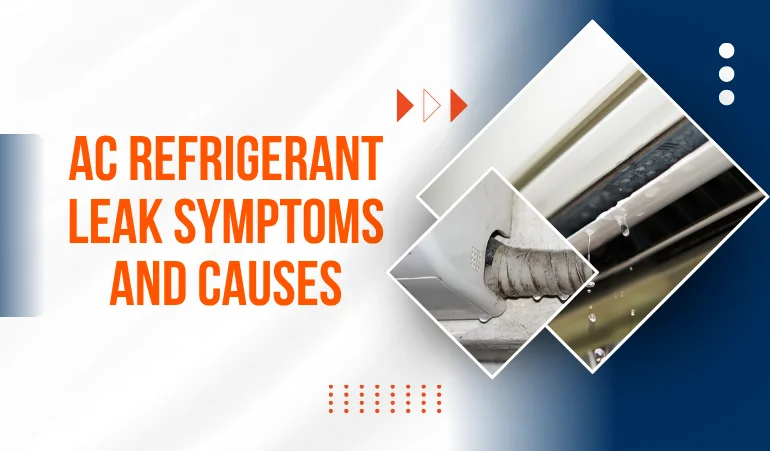
When your air conditioner suddenly stops cooling as it used to or you notice an unexplained spike in energy bills, a refrigerant leak might be the culprit behind it. This issue is small and often goes unnoticed initially. But with time, it worsens, damaging critical components, reducing efficiency, and leading to costly HVAC failures. Such issues are more common in Pennsylvania and New Jersey, as these regions face extreme climate fluctuations and seasonal swings. The older or poorly maintained systems are more vulnerable to developing these problems.
In this blog, we will uncover the most common symptoms of refrigerant leaks, their causes, and what to do when you face a similar situation.
When there is insufficient refrigerant in your air conditioner, the heat transfer process is disrupted. As a result, the cooling capacity of the system decreases, resulting in the AC blowing slightly warm or unconditioned air inside the space. When left ignored, it can compromise your comfort, put an extra strain on the HVAC system, and increase your utility bills.
When there is reduced refrigerant in the AC, there is a significant decline in the temperature and pressure. With a significant reduction in refrigerant levels, the temperature of the coils falls below the freezing point. This is the point where ice formation starts around the AC coils. If you leave this issue unaddressed, it can completely envelop the coils. Now, AC struggles to absorb the heat from the indoor air and provide cooling to the space.
Hissing and bubbling sounds are produced when pressurized refrigerant escapes through narrow holes and cracks and mixes with the air outside. Homeowners easily notice and instantly confirm such sounds. If homeowners do not address these issues, the system will underperform, struggle to meet cooling needs, and ultimately fail.
When the refrigerant levels are low, the air conditioner has to work harder to meet the desired comfort levels. It uses more energy and runs longer cycles. The result is a steady, unexplained rise in energy bills despite the same usage pattern and comfort levels. Especially in Pennsylvania and New Jersey, where air conditioners run heavily due to humid summers, this increase in bills is significantly higher.
When the refrigerant is lower due to leaks, the air conditioner is unable to remove the heat effectively. As a result, it operates on longer cycles and for more time to compensate for efficiency. Many times, AC keeps working continuously and doesn't shut off properly. These longer cycles place an extra burden on the internal components, which may experience accelerated wear and tear and, in some cases, complete failure. We frequently observe this pattern in PA and NJ during the peak summer months.
This is a repeated question we hear at Lehigh HVAC. The answer is a big "YES." AC leaks are something more than performance issues or increased energy bills. They are very serious and can lead to malfunctioning core components, sudden breakdowns, and even complete HVAC failures. Such an outcome is the least you want to see as a residential or commercial HVAC customer.
Apart from this, AC refrigerant issues also raise serious safety and environmental concerns. It can release volatile chemicals that make your home's air unbreathable and also leave serious effects on the environment. Delaying leaks further escalates the situation and may cause irreversible damage to your HVAC systems.
Over time, HVAC components face wear and tear. It can lead to small cracks and gaps in refrigerant lines. Refrigerant can quickly escape from these tiny openings and slowly decrease the levels available for usage. The leakage is small and often goes unnoticed at the start. However, it gradually becomes significant, and performance issues start displaying. This phenomenon is especially common in New Jersey and Pennsylvania, where systems undergo heavy seasonal use.
Poor or inappropriate installation techniques also cause refrigerant leakage issues. Failures in installation, such as improper brazing, unsealed connections, or over-tightened fittings, create weak points in the closed leaks. Refrigerant can quickly escape through these openings. In Pennsylvania and New Jersey, such issues are more prevalent as these areas undergo sudden shifts from hot summers to freezing winters, accompanied by contraction and expansion of refrigerant lines.
Faulty, old, or excessively used HVAC components are also responsible for refrigerant leaks. Old copper coils, weak joints, and worn-out rubber seals can create small pinholes in the refrigerant lines. The liquid then uses these holes as a pathway to escape outside. Replacing those corroded or damaged components with the new ones can, however, prevent these issues in the future.
It is the most direct cause of refrigerant leaks. Corrosion creates microscopic, pinhole-sized punctures in the copper tubing and evaporator coils. This process is sometimes due to chemical reactions with moisture and atmospheric pollutants that deteriorate the metal over time. The process is further accelerated in the NJ and PA areas, where freeze-thaw cycles and extended off-seasons cause corrosion to refrigerant lines.
We wish you never face a refrigerant leak in your life. But if you experience such a stressful situation, you should handle it safely.
Turn Off the AC: Turn the AC off at the thermostat level. Running it at a low refrigerant level can burn the compressor.
Ventilate the Area: Open windows and doors immediately. Although modern refrigerants are not toxic like the older ones, inhaling them can still cause nausea and dizziness.
Call a Professional: Attempting a DIY is never safe. Call your nearby, local HVAC pros for immediate help.
If you are anywhere in Pennsylvania or New Jersey, Lehigh HVAC is always available for emergency HVAC service. Ring us a bell at 484-961-7044 and find us there in no time.