Contact Info
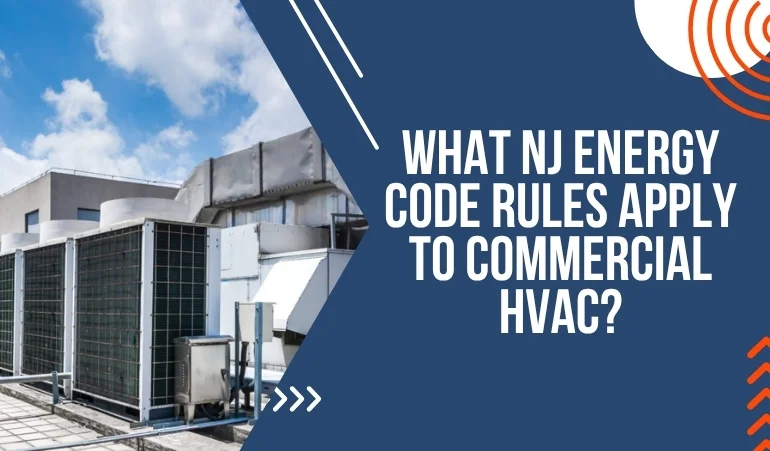
New Jersey is a strictly organized state. You need a permit for every major mechanical installation in this state, and you have to follow specific rules and code standards. These rules and regulations ensure every installation and major service meets the standards. It also ensures minimum risk of environmental damage, including its biotic and abiotic factors.
In this blog, we will discuss those energy code rules that need to be strictly followed in New Jersey in order to make your commercial HVAC service above the mark.
The requirements are multidirectional, and that’s why you need to pass multiple checkpoints. Here is a brief breakdown of what you need to follow.
There are two primary pathways to check the code compliance of commercial buildings. The first one is through software by the U.S. Department of Energy, COMcheck. It passes your HVAC installation only if its equipment efficiencies, insulation, and controls meet or exceed baseline requirements. The second one is by utilizing Section C407. It checks the whole-building energy size against a standard baseline.
While choosing HVAC equipment, you have to seek a balance between energy efficiency, capacity of the unit, and its SEER2 or EFUE ratings, depending on the equipment type. The minimum efficiency standards for most commercial buildings are 14 SEER2 ratings for air conditioners and over 81% EFUE ratings for furnaces. Air-water economizers are usually required to provide cooling when outdoor temperatures are normal. Furthermore, you need programmable thermostats, zone shutoff dampers, and optimal start controls to prevent energy wastage during unoccupied hours.
Systems must adhere to ventilation standards to ensure a comfortable workplace. There are two primary additions in this regard.
Demand Control Ventilation (DCV)
It is necessary to modulate outside air in highly dense spaces such as conference rooms or auditoriums.
Energy Recovery Ventilation (ERV)
It is required in HVAC systems that pull high volumes of outside air to recover heating or cooling energy from the exhaust air before it is expelled outside.
Sealing and insulating HVAC ducts is essential to prevent conditioned air wastage. It also mitigates the risks of fungal growth and highly polluted air inside your commercial space. The requirement is to ensure that all your supply and return ducts that are located outside the conditioned spaces must be fully sealed and insulated. Pressure testing is often required to rule out any risks of even the smallest duct leaks.
Larger facilities with complex systems need comprehensive commissioning to ensure they work exactly as they are intended to. It involves checking thermostat functionality, testing the equipment under various circumstances, and ensuring it handles the comfort desired at the place. Furthermore, compliance documents are required to be signed only by an NJ-licensed professional engineer. It proves that the equipment, installation, and commissioning were all just according to the standards.
Commercial HVAC installations are very complex jobs that need utmost care. Even a slight mistake at any stage can render the entire process below standard. The team at Lehigh HVAC recommends avoiding the following mistakes so you complete the process swiftly and smoothly.
Lehigh HVAC is a professional, licensed HVAC agency in New Jersey. Our experienced technicians, advanced equipment, and in-depth HVAC expertise enable us to deliver every HVAC project above the mark. Contact us if you need expert care for your business’s thermal comfort.