Contact Info
As the HVAC industry is going through a phase of revolution, various innovative and modern heating and cooling systems are becoming popular. Multi-split systems are one of those. These HVAC appliances are accompanied by multiple features, including individualized temperature control, space-saving designs, and energy efficiency. If you are thinking about upgrading your home’s or business’s HVAC system, a multi-split system can be the best choice. But before you rush to buy a unit or book a contractor service, having a basic idea of the setup and working mechanism is a great practice.
This blog covers the basic details about multi-split systems, including an introduction, how they work, benefits, and their comparison to single-split units.
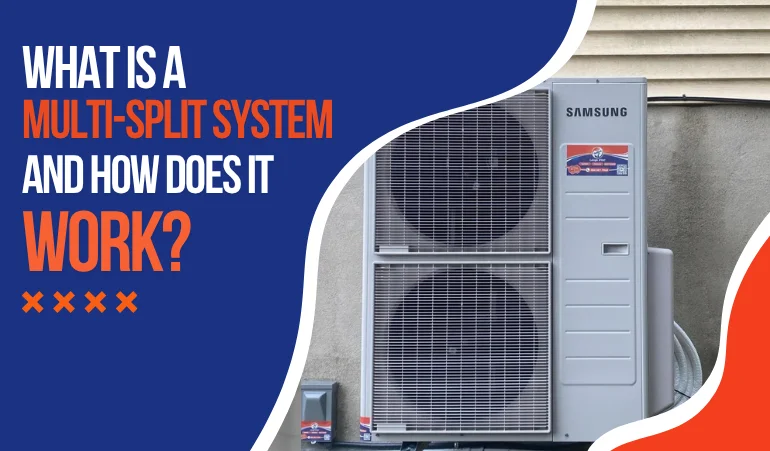
A multi-split system is an HVAC system that connects multiple indoor units to a single outdoor unit. This unique setup assigns a specialized air handler to every room, while the outdoor unit remains the same. The advantage of this apparatus is that it allows homeowners or facility managers to monitor temperature across every zone independently. Shifting the temperature by a few degrees higher or lower in one room doesn’t affect the temperature setting in the remaining rooms.
A multi-split system comprises multiple other crucial components beyond the outdoor unit and indoor air handlers. Here are some essential components of this apparatus.
Compressor
Condenser coils
Outdoor fan
Expansion valve
Accumulator
Air handlers
Evaporator coils
Blower fan
Air filters
Refrigerant line set
Condensate drain line
Individual thermostats
Multi-split systems work similarly to single-split systems. A heat pump absorbs or releases heat and then sends this heat inside (in winter when heating is in demand) or outside (in summer when cooling is in demand). But because multi-split systems have multiple indoor air handlers, users can adjust the temperature of every single room through its dedicated thermostat.
Here is how the process works.
Multiple indoor units are connected to the single outdoor unit
The connections are made through refrigerant lines
There is no need for bulky ductwork installation in such systems
The refrigerant transfers the heat between indoor and outdoor units
The conditioned air is blown inside the space through blower fans
The benefits of a multi-split system go far beyond personalized temperature control. Here is what you can expect.
Allows customized temperature control in different rooms.
Eliminates the need for bulky ductwork installations.
Lowers monthly energy bills through targeted zoning.
Operates much quieter than traditional central systems.
Adapts well to changing Pennsylvania seasonal weather.
Improves indoor air quality with multi-stage filtration.
Fits easily into older homes without remodeling.
Provides both efficient heating and cooling performance.
The difference is basically in the indoor units. The main working mechanism stays the same. Here is how they differ.
Feature |
Multi-Split System |
Single-Split System |
|
Outdoor Units |
Connects multiple indoor units to one outdoor compressor |
Requires a dedicated outdoor unit for each indoor unit |
|
Indoor Capacity |
Powers 2 to 5+ independent indoor air handlers |
Powers only 1 indoor air handler |
|
Temperature Control |
Independent thermostat settings for every individual room |
Single temperature setting for the entire covered area |
|
Upfront Cost |
Higher equipment and installation expense |
Lower initial purchase and setup cost |
|
Ideal Application |
Multi-room homes, retrofits, and multi-story layouts |
Single rooms, studio spaces, or small additions |
|
Exterior Footprint |
Saves outdoor space with a single compact compressor unit |
Requires extensive outdoor wall space for multiple compressors |
|
Energy Efficiency |
High efficiency via targeted zone cooling and heating |
Lower relative efficiency when cooling multiple rooms |
|
System Redundancy |
Outdoor unit failure impacts all connected indoor zones |
Outdoor unit failure impacts only that single room |
Lehigh HVAC is a professional agency, serving Pennsylvania with on-demand heating and cooling services. Our costs are affordable, technicians are on-demand, and support is open 24/7. Feel free to reach out if you need expert installation for your multi-split system. Also, save 484-961-7044 for emergencies.