Contact Info
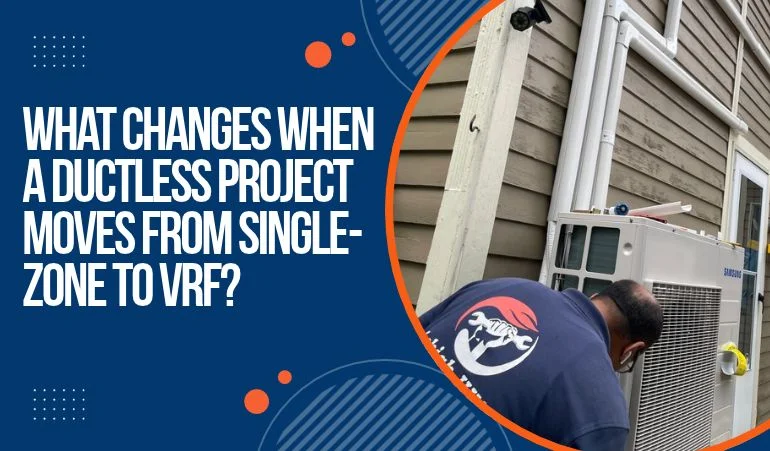
A single-zone mini-split unit cools or heats only a single, specific zone. Its setup is pretty straightforward: one indoor unit connected to one outdoor unit through refrigerant lines. On the other hand, a VRF system needs a different installation approach, as it connects multiple indoor units to a single outdoor unit. A single zone system is used to control the temperature of only one zone, while a variable refrigerant system (VRF) is used when multiple zones require separate temperature control.
Lehigh HVAC recently completed a ductless mini-split installation project in Pennsylvania. The client needed a mini-split and VRF installation. The team installed multiple indoor units at zones where they were required and connected them to the single outdoor unit, so every room gets separate temperature control. This guide walks you through what changes when the project moves from mini-split to VRF configuration.
A single-zone mini-split system requires air conditioning control for one specific area only. But when the project moves to VRF, the number of conditioned zones increases from one to multiple. For example, a home might require air conditioning in only one zone where the family spends most of its time. That’s why they may install a single-zone mini-split in that area. On the other hand, a commercial space usually has multiple zones, including office, meeting room, staff room, waiting area, etc. Every zone requires separate temperature control managed through the VRF system.
When it is about selecting a single-zone mini-split system, the job is relatively less complex. The technicians evaluate the space heating and cooling requirements and choose a system with a compatible size. On the other hand, when the technicians have to select the equipment for VRF systems, the process is repeated for every zone wherever it is needed.
Here is what contractors usually consider during this process.
Heating and cooling loads across all zones
Number and capacity of indoor units
Combined connected indoor capacity
Expected simultaneous heating and cooling demand
Manufacturer equipment and operating limits
A single-zone mini-split requires straightforward connection to the refrigerant. The unit is mounted on the wall and connected to the refrigerant lines. But when it comes to the VRF systems, the process becomes more complex. The refrigerant piping becomes much more complex, as now the refrigerant has to be connected to all the indoor units. This added complexity adds to the extra labor hours and overall project complexity and thereby increases the total project cost.
A single zone works on its own according to the thermostat setting and the indoor temperature conditions. Nothing else interferes with the pathway. But when the project moves to the VRF systems, all the zones have to work in coordination. This is required to distribute the heating or cooling required by every zone without putting extra burden on the equipment. The smooth communication between the indoor units themselves and between the outdoor unit ensures every zone gets the comfort as per its requirements.
The decision depends on the number of conditioned areas, building layout, operating schedules, available outdoor space, and required temperature control. Here is how contractors compare.
Project requirement |
Potentially suitable approach |
|
One room needs heating and cooling |
Single-zone mini-split |
|
Several separate rooms need conditioning |
Multi-zone ductless system |
|
Larger building with multiple independently controlled zones |
VRF system |
Lehigh HVAC is a certified HVAC agency in Pennsylvania, serving both residential and commercial customers for reliable mini-split and ductless installation services. From the initial site survey to final quality checking, only certified technicians handle your project. Contact us at 484-961-7044 to obtain an estimate for your project.