Contact Info
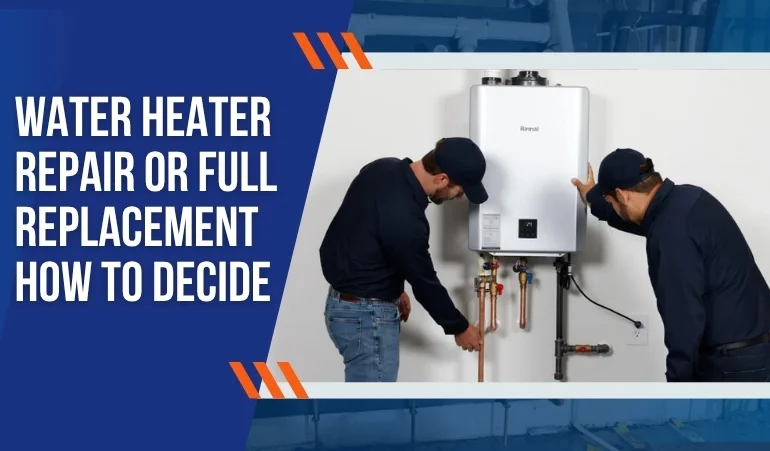
Whether to repair or replace your water heater in New Jersey depends on several factors, including age, repair cost, and efficiency of the system. If the system is under 8 years old and has components in good working condition, repair is an ideal choice. But if it is above 8 years old and many of the components are in compromised condition, requiring frequent upgrades or troubleshooting, a replacement would be the best fit. Another approach to deciding repair vs. replacement is the 50% rule. It states that when repair costs exceed 50% of a new unit, replacement should be preferred over repairs.
But these rules are not absolute. The right decision always comes after evaluating your case, understanding the equipment and prices, and considering customer needs.
This guide is designed to make repair vs. replacement decisions easier.
Industry experts usually rely on the two standard principles when deciding between repairs and replacements.
Compare the new equipment cost (including installation) with the repair charges. If the repair costs exceed or equal the new installation cost, replacement is the preferred choice. However, it is recommended to look at how many components need repairs. If a single component is developing issues repeatedly, replacing that single part makes the best sense instead of the complete equipment.
As the name indicates, this principle considers equipment age and repair cost as two of its dependent variables. Multiply the age of the equipment (in years) by the repair price (in $). If the result is more than 5,000, replace the unit. If the result is less than 5,000, repair the unit.
Example Scenario:
If your system is 9 years old and you got a repair quote of $600, replacement is an economical choice for you, as the result of multiplication is 5,400 (9 × 600), which is greater than 5,000.
Repair vs. replace decisions for water heaters depend on workload, equipment condition, and climate. In New Jersey, climate impact is non-negotiable, as it has snow, chill, and freezing temperatures that put water heaters under pressure.
|
Decision Factor |
Repair It If... |
Replace It If... |
|
Unit Age |
Under 8 years for tank models Under 12 years for tankless models |
Over 10 years for tank models Over 15 years for tankless models |
|
Repair Cost |
Less than 50% of new unit cost |
Greater than 50% of new unit cost |
|
Primary Issue |
Failed element, bad thermostat, bad valve |
Leaking tank, internal rust, heavy sediment |
|
Energy Bills |
Stable and normal |
Spiking due to lost heating efficiency |
|
Performance |
The hot water supply is consistent |
Frequent lukewarm water or total loss of hot water |
Certain red flags rule out every decision criterion and require replacement at the earliest convenience. Here is what it includes:
If you see water pooling around the tank base, replace the unit immediately because it would usually have a fracture in the inner tank lining. Small corrosion and sediments can, however, be sealed effectively.
If you see rusty or discoloured water from the warm water taps and clear water from the cold water taps, it is a clear sign that the internal lining is flaking away. When corrosion signs become visible, the fracture is only a few days behind.
Large rumbling, popping, or grinding sounds indicate a sediment buildup due to mineral scale at the base of the tank. It causes corrosion, fractures, and severe leakages, making your water heater non-functional soon.
If you have to pay for repairs more often, the solution is probably a replacement instead of repairs. It especially happens when the system is nearing the end of its life stage or more than one of its components is developing the need for repairs more often.
|
Unit Type |
Repair Cost |
Replacement Cost (Parts & Labor) |
|
Standard Electric Tank (50 gal) |
$150 – $450 |
$1,200 – $2,200 |
|
Standard Gas Tank (50 gal) |
$200 – $500 |
$1,400 – $2,600 |
|
Tankless Water Heater (Gas/Elec) |
$300 – $700 |
$2,500 – $4,500+ |
|
Hybrid Heat Pump Water Heater |
$250 – $600 |
$2,200 – $3,800 |
The choice of repair or replacement doesn’t just revolve around the price, age, and equipment condition. It also depends on the evaluation and assessment of the equipment, previous repair records, energy efficiency, and performance. And for this purpose, you need to rely only on someone knowledgeable, experienced, certified, and trustworthy. Because only the right person can carry out the right site analysis and figure out the right causative agent. And only if you understand the culprit can you prevent future repairs. We recommend checking the licence, experience, and reviews by local customers before saying "YES" to a specific contractor.
New Jersey customers can hire Lehgih HVAC with confidence, as we have the highest customer satisfaction rate in the region. Ring us a bell at 848-361-4707 whenever and wherever you need us.