Contact Info
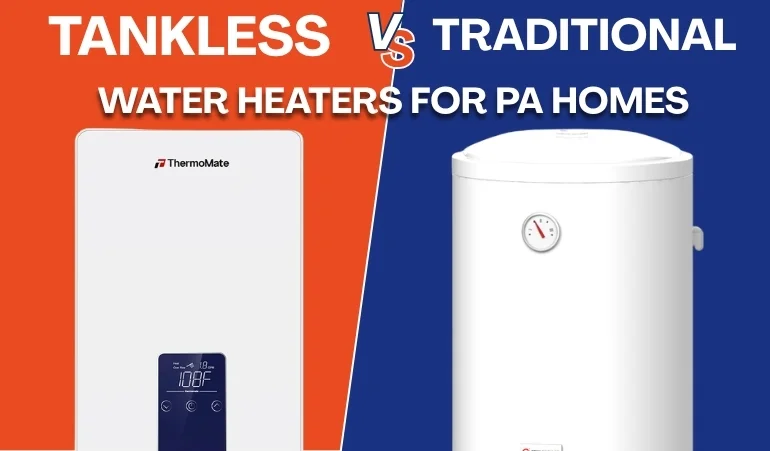
Tankless water heaters are relatively advanced models that occupy less space and conserve more energy. They provide an on-demand water supply without any storage capacity. Traditional water heaters come with a storage tank as a reservoir. Once the tank is depleted, they run out of supply. And because they warm the whole water tank, they waste a significant amount of energy. Choosing the one for your Pennsylvania home or business needs a more detailed approach than just warmth and water supply. You have to balance equipment and installation costs with long-term energy savings to make the best use of your investment.
This blog focuses on a comparison of traditional vs. tankless models of water heaters. It will help you choose the right one for your PA facility so you both stay comfortable and pay reasonable bills.
They are also known as storage water heaters. They come with an attached, insulated tank to store 30 to 80 gallons of water. This water is continuously heated and remains available to supply. Their primary feature is that they supply water from multiple taps simultaneously. The fuel source can be natural gas, propane, or even electricity.
As the name indicates, they come without any attached tank. This is why they provide an on-demand water supply. These heaters are relatively modern, updated versions of traditional models that bypass both storage tanks and standby energy loss. Being tankless, they save space. However, their output flow is limited compared to traditional models. They also run on both gas and electricity, depending on the fuel availability in your region.
|
Feature |
Storage Tank |
Tankless |
|
Water Delivery |
Batch (30–80 gal) |
Continuous (On-Demand) |
|
Multi-Tap Flow |
High |
Limited by GPM |
|
Floor Space |
~12 sq. ft. |
Zero (Wall-Mounted) |
|
Life Expectancy |
8–12 yrs |
15–20+ yrs |
|
Efficiency (UEF) |
0.60 – 0.70 |
0.82 – 0.95 |
A storage heater is just like a reservoir. It stores tens of gallons of warm water ready for use. As someone in your home opens a faucet, the warm water leaves the reservoir and drains through the open faucet. If you run multiple faucets, a shower, and washing machines simultaneously, it will keep on delivering water from the tank. As the warm water leaves the tank, cold water joins the tank and starts getting warm. If all the reserved water is consumed, you have to wait 30 to 60 minutes for the heater to warm the water before the supply resumes.
Tankless heaters provide an on-demand water supply. It means they don’t warm water before usage. Once someone in your home turns on the faucet, the heater immediately warms the water and delivers it. It has a negative side, as well. The capacity of tankless heaters is measured in gallons per minute (GPM). It means that if you open multiple water sources simultaneously, which exceeds the heater’s output, it won’t deliver the same output to all the taps. But unlike storage heaters, you won’t have to wait for hours to get the water supply again.
Water temperature can drop to 40°F–52°F during cold winter days in Pennsylvania. To deliver a consistent supply of warm water at 120 °F, the heater has to lift the temperature by up to 70 °F. Bridging this gap requires significant energy and time. For traditional storage heaters, you can expect additional time for heating the cold reservoir. For tankless heaters, it means a reduced output flow rate. For example, a heater that delivers 7 GPM in summer reduces to 6 or 5 GPM during this extreme chill.
These facts make it essential for PA homeowners to plan their water heaters according to the actual winter thresholds instead of relying on the summer output.
Much of Pennsylvania, especially areas drawing from limestone-rich aquifers, experiences moderate to heavy water hardness. This hard water, when heated in the heat exchanger, can deposit its minerals on component surfaces. As time passes, these minerals create corrosion issues that demand component replacements. These minerals also settle in the tanks of storage heaters, but they leave fewer negative effects because of the high volume of those storage tanks.
An annual flush with vinegar is recommended to prevent these issues. Apart from this, other maintenance steps are also non-negotiable in these PA areas with high water hardness.
Purchasing decisions are not just influenced by performance and output. Costs also play their role in making the right choice.
|
Financial Factor |
Traditional Storage Tank |
Tankless System |
|
Initial Cost (Installed) |
$1,300 – $2,500 |
$3,500 – $6,000+ |
|
Installation Complexity |
Simple swap |
High (Venting/Gas upgrades) |
|
Annual Fuel Spend |
Higher (Standby losses) |
15%–30% lower |
|
Service Needs |
Periodic tank flush |
Annual descaling flush |
For your case, the ideal system is the one that strikes a balance among installation cost, output, and ongoing operational charges.
A Traditional Storage Heater Is Ideal If
A Tankless Water Heater Is Ideal If
Choosing between a traditional and a tankless water heater comes down to balancing upfront cost with the comfort and long-term value. Tankless systems provide on-demand supply, but they cost more upfront. Traditional models are relatively less expensive but are not that efficient and take 30 to 60 minutes every time the tank is heated. The ideal choice depends on your home assessment and budget preferences.
If you are not sure about which water heater makes the best sense, an assessment with Lehigh HVAC can help you make a more confident decision.