Contact Info
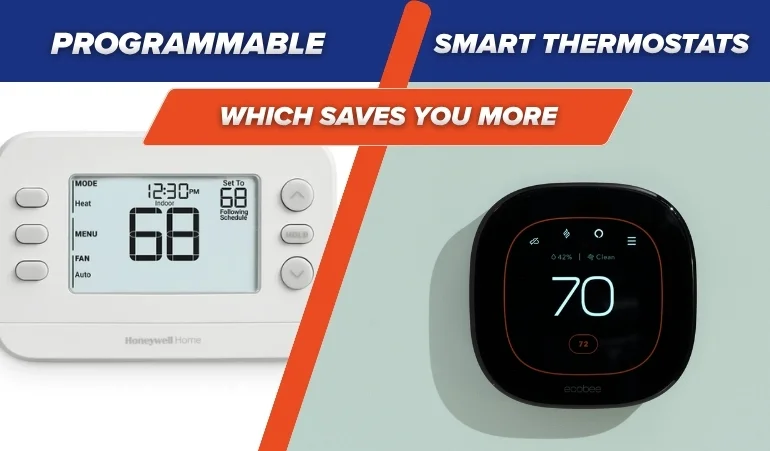
Smart and programmable are two advanced thermostat models commonly used in Pennsylvania. Each has its own pros and cons. Programmable thermostats follow the settings you apply yourself. Smart thermostats, on the other hand, learn from your daily life activities and adjust automatically. In Pennsylvania, where winters are snowy and summers are hot and humid, the right thermostat is non-negotiable. It keeps your space at a comfortable temperature, reduces energy bills, and meets on-demand heating and cooling requirements.
In this blog, we will compare these two models for upfront costs, annual savings, and payback period. Smart thermostats generally cut down energy bills by 10 to 15%, while programmable thermostats reduce them by 5 to 10%. This makes smart thermostats a better cost-saving option in most cases. But it doesn’t mean they are the best option. In many cases, programmable thermostats make the best sense. The right choice depends on many factors, including your budget, lifestyle, and comfort goals.
Let’s discuss the detailed stuff in the following sections.
Programmable thermostats don’t connect to Wi-Fi. You program them and set a daily and weekly schedule directly on the device. The thermostat then keeps your home’s heating or cooling unit to the set schedule regardless of climate conditions. They save only what you set, nothing on their own. You can save more only by updating settings manually on the device.
Smart thermostats connect to Wi-Fi. That’s why they offer easy monitoring, energy tracking, and updates from a smartphone or laptop. Second, they can automatically adjust heating and cooling cycles, even if you don’t set it manually. They can sense your presence in the home through geo-fencing. It means they can slightly increase the home’s temperature in summer and slightly reduce it in winter, when you are away.
The real savings are not limited to energy bills. They also count initial cost, lifespan, and energy savings. Here is a brief comparison of factors that matter most.
Programmable thermostats cost less up front than smart models. You can expect to pay $30 to $100 for programmable models and $100 to $250+ for smart models. The installation is pretty straightforward. Sometimes you need a pro for wiring and setup, which can add $50 to 100. Expert installation is recommended, as it reduces the risk of inaccuracies and poor performance due to incorrect settings.
Some utilities offer rebates for smart thermostats, which can make the purchase affordable. Even without rebates, long-term energy savings and lower utility bills justify the upfront cost for smart models.
Smart thermostats usually offer better annual energy savings. Programmable models also offer that, but they are one step behind smart models. Stats show programmable models trim annual energy costs by 5 to 10% while smart models reduce them by 10 to 15% and sometimes even higher. Savings depend on the thermostat settings, neighborhood climate, and home size. For example, a large home can cut down a lot during peak summer days with strict energy-saving settings.
If we compare the average annual savings of both models for the same home, while keeping the thermostat in the best energy-saving mode, the smart thermostat wins here.
The payback period is how long it takes a thermostat to pay off the initial investment. The payback period for programmable thermostats is generally 6 to 8 months, while it is 1 to 3 years for smart models. These numbers are not absolute and can vary. For example, it depends on climate, user behavior, and home size.
In standard settings, programmable thermostats have shorter payback periods because of lower upfront costs.
Both thermostats aim to cut energy costs. But they do so by different mechanisms. The programmable version allows you to set a fixed weekly or daily schedule. It is good if you have a steady work routine. On the other hand, smart versions learn from your lifestyle and adjust heating and cooling cycles. They are good if your lifestyle is unpredictable.
Here is what Lehigh HVAC recommends.
Lehigh HVAC has served Pennsylvania with reliable service for over 11 years. From battery-operated models to smart thermostats, we are experts in all HVAC devices. Contact us anytime, anywhere you need professional HVAC services.