Contact Info
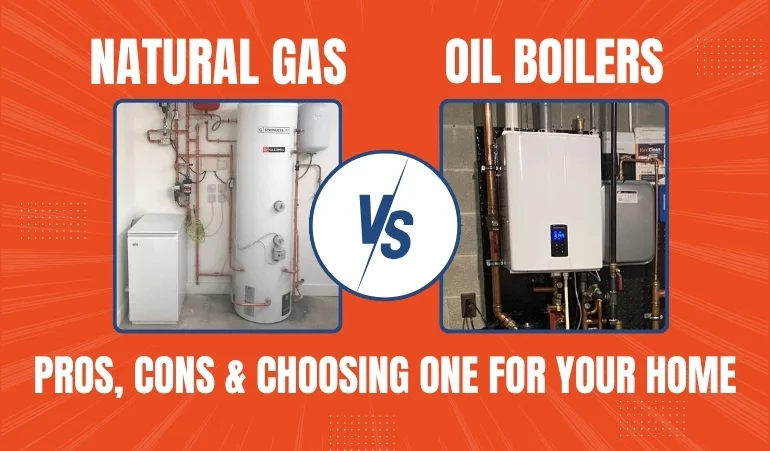
When it comes to winter comfort, oil and gas boilers are the two widely sought-after options. Each has its own pros and cons and plays its role better for a specific climate and building symmetry. Choosing the right one is essential for reliable warmth throughout the winter. This decision also affects energy bills and maintenance costs, which is why it is essential to choose the right system for your PA home.
In this blog, we will outline a detailed comparison of both HVAC appliances with respect to home heating comfort in PA and the suitability for a specific climate in Pennsylvania.
Before we dive specifically into the pros and cons of gas boilers for Pennsylvania homes and climate, let us first absorb the superficial knowledge of this appliance. This basic knowledge would help you to choose the right unit according to our unique comfort needs.
As the name implies, this specific boiler type uses natural gas as its fuel source. Gas is burned in the combustion chamber. This process generates heat energy, which is used to warm the water. This water is then circulated through pipes and distributed in the various parts of the home to provide heating comfort.
Here are the main components of a natural gas boiler with their functions.
Burner: This component is responsible for generating heat energy by combusting the fuel source.
Combustion Chamber: This is the section where the combustion process actually takes place.
Heat Exchanger: This component transfers the heat generated in the combustion chamber to the water flowing in the pipes.
Control System: This is the part that monitors all functions of the boiler and controls its on-off cycles.
Safety Features: Various safety valves are also added that automatically open to release the excess pressure when it crosses safe limits.
After you are done with boiler installation at your PA home, maintenance is the key to keeping it performing at its best. A gas boiler generally needs annual maintenance. It involves inspecting pressure, bleeding the radiator, checking for leaks, along a physical inspection of wear and tear.
Oil boilers are similar to natural gas boilers with only minor differences in the working mechanism, operations, and components. The primary difference is in the fuel source, as oil boilers rely on oil as a fuel source.
An oil boiler generates heat by igniting heating oil in the combustion chamber. When the thermostat signals a need for heat, oil is pumped into the combustion chamber, where a spark ignites it. The resulting flame heats the heat exchanger, which in turn warms the water. This warm water is circulated through pipes to warm the building.
Here are the most important components of an oil boiler.
Burner: It injects the heating oil into the combustion chamber and mixes it with air to create a flame.
Combustion Chamber: It is an enclosed compartment where oil is ignited and heat is generated.
Heat Exchanger: It includes a series of tubes or plates that transfer heat to the water.
Controls: It includes sensors that monitor the temperature and regulate the boiler’s operation.
Stack: It includes the chimney that safely exhausts the combustion gases.
Oil boilers need more intensive maintenance due to the production of soot. They require annual replacement of the nozzle and oil filter and regular cleaning of the components. The professional service inspects for any signs of corrosion, leaks, and component damage.
Gas-fired boilers have several benefits, which is why this is the most widely used boiler type in Pennsylvania. Here are some of the primary advantages;
High Efficiency: Natural gas boilers are much efficient as they have a clean ignition process and a huge proportion of input energy is turned into output.
Low Bills: In many areas of Pennsylvania, natural gas is relatively cheaper than oil, and that’s why gas boilers have lower bills.
Ease of Operation: There is no need to manually fill the oil tank. Just connect the boiler with the gas supply and keep it running smoothly.
Eco-Friendliness: Natural gas boilers are more environmentally friendly as they involve fewer carbon emissions and a reduced negative impact.
If natural gas boilers have many benefits, a lot of disadvantages are also associated. Here are the top drawbacks of choosing a gas boiler.
Limited Availability: Natural gas supply is not available in all areas of Pennsylvania. Therefore, many rural customers can’t choose it for winter comfort.
High Installation Costs: Residential boiler installation in PA is associated with high installation costs initially. The unit’s price is also higher compared to other units.
Risk of Gas Leaks: Gas leaks can be very hazardous, sometimes leading to explosions and fire hazards.
Natural gas boilers are perfect for urban and suburban areas with easy access to a gas supply. They are also a great option for homeowners looking for long-term cost savings.
Although these boilers are not widely used in Pennsylvania, they have multiple benefits associated with them. Especially for the rural communities in Pennsylvania lacking a stable gas supply, they are very beneficial.
Fuel Independence: Oil boilers come with the freedom of fuel supply. You don’t require any sort of grid access; you can enjoy comfort anywhere, anytime.
Longer Lifespan: Oil boilers can last up to 20-30 years if kept in good condition and regular maintenance.
Quiet Operation: Oil boilers don’t use blowers, and therefore they are accompanied by much quieter operation.
Powerful Heating: Oil boilers are often considered a powerful source of heating and can warm a home despite frosty cold outside.
As oil boilers offer multiple benefits, there are also some disadvantages; therefore, multiple customers avoid purchasing them.
Unstable Prices: The costs of oil are consistently changing according to the global market and supply conditions.
Hassle of Storage: Oil needs to be stored in large tanks, which definitely occupies some space. This is a real trouble for small homes.
Impact on Environment: Oil boilers are relatively less eco-friendly and are accompanied by more carbon emissions.
Oil boilers are best used for rural communities like those in Carbon County or the areas that are far from the natural gas supply lines.
There are many types of boilers you can get installed in Pennsylvania. What plays the role better for your house depends on the region, fuel availability, comfort needs, and building symmetry. If you live in an area with access to a gas supply, want less maintenance, or are inclined towards long-term cost savings and lower energy bills, natural gas boilers are the perfect choice for you. On the other hand, if you belong to a rural area without a gas supply, and your home can accommodate an oil tank, you should choose an oil boiler. Additionally, oil boilers are a better option if you need more powerful heating in extreme winters.
Choosing between an oil and a gas boiler is an important decision that needs careful consideration of multiple factors. Having a clear understanding of fuel availability, system prices, installation costs, maintenance requirements, efficiency, and environmental impact of each appliance can help you make an informed decision for your winter comfort. Make sure the system you have chosen is compatible with your building's symmetry and comfort goals. Additionally, balance your budget preferences with long-term energy-saving goals to get the best from your investment.
If you are still confused about choosing the right boiler for your PA home, the Lehigh HVAC team is here to help. We will assess your home’s symmetry, the climate strain, fuel availability, and geographical factors, and suggest the best unit. After this, we will help you with the precise residential HVAC installation of your newly purchased boiler according to the industry’s best standards. Contact us at 484-961-7044 to discuss your project.