Contact Info
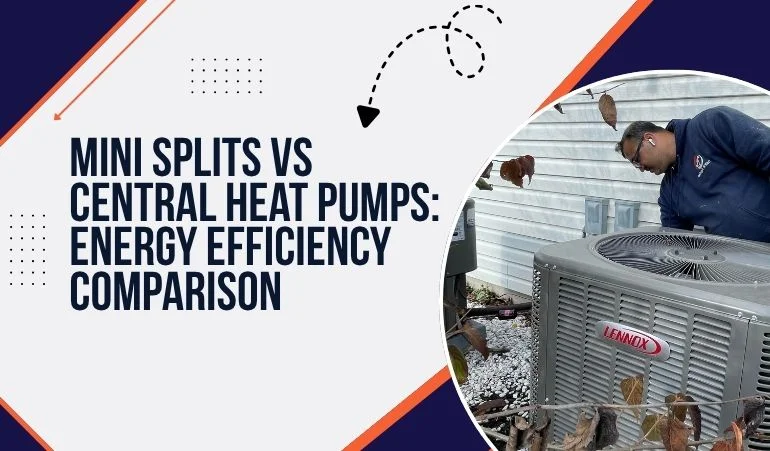
You might have seen our technicians advising you to use heat pump models for both cooling and heating. The reason for this advice is justified by the high efficiency, premium comfort, and reliability of heat pumps. These innovative HVAC systems are far better than traditional air conditioning models. Though it is clear that heat pumps are a great option, one question still remains unanswered: should I choose a central heat pump or a mini-split heat pump? The question becomes more important when you live in Pennsylvania, a state characterized by 4 seasons, sweltering summers, freezing winters, humidity, and snowstorms.
The answer to the above question is straightforward. Choose a central heat pump system if your home has a precise duct network. Choose a mini-split system if your residential or commercial space lacks ductwork. This was the main difference. But the choice between mini-split and central heat pump systems depends on several other factors, which we are going to explore in this comparison guide. By the end, you will be able to choose the right system for your specific space and climate needs.
Before diving into details, here is how both systems differ.
Feature |
Ductless Mini-Split |
Central Heat Pump |
|---|---|---|
|
Ductwork Required |
No |
Yes |
|
Energy Efficiency |
Higher (no duct loss) |
Moderate (10–30% duct loss) |
|
Zoning Control |
Individual room control |
Whole-house uniform |
|
Upfront Cost |
Higher per zone/unit |
Lower if ductwork exists |
|
Installation Complexity |
Easy (small wall penetration) |
Complex (requires ducting) |
|
Visual Impact |
Wall-mounted indoor units |
Hidden (discreet vents) |
|
Ideal Use Case |
Additions, ductless homes |
Homes with existing ducts |
Contact Lehigh HVAC if you need heat pump installation service in Pennsylvania.
This question has no universal answer. Though we have witnessed that mini-split systems use less energy overall. These energy savings are achieved through zoning technology, personalized temperature control inside every room, and the prevention of energy wastage through the duct network. Central heat pumps, on the other hand, are energy efficient as well. Most homeowners and business owners are concerned with the energy loss that occurs through the ductwork. It is true that central heat pumps may lose up to 30% of energy due to ducts between the outdoor unit and the indoor air handlers. You can save this energy by perfectly sealing the HVAC ducts and minimizing leaks, cracks, and gaps.
In short, mini-splits seem to conserve more energy, but you can achieve a similar level of energy efficiency by choosing a highly efficient unit and accurately sealing the ducts.
Winters in Pennsylvania are nothing less than a nightmare. They bring sub-zero temperatures, accompanied by snowstorms and cool breezes. A standard heat pump system struggles at such low temperatures. Therefore, it is recommended to check the cold-weather performance before making a purchase. Many homeowners make the mistake of choosing a system that is just efficient for the cooling season and leaves the family out of comfort in the winter. We recommend that you check the specifications of the system, confirm how much winter temperature can it tolerate while maintaining reliable comfort, and then compare it with the climate conditions in your region. Whether you choose a mini-split or a central heat pump, make sure it handles every season without losing performance.
A ductless mini-split system is a better choice compared to a central heat pump model when:
Your home has no existing ductwork
You are adding a new room or addition
Some rooms are difficult to heat or cool
You want independent room temperature control
Extending ducts would require major remodeling
A central heat pump installation is a smarter decision when:
Your home already has functioning ductwork
You prefer a consistent whole-house climate
You want a hidden system without wall-mounted units
You are replacing an existing central AC or furnace
You want lower upfront costs for a multi-room setup
Lehigh HVAC is a professional heating and cooling service company in Pennsylvania. We service almost every make and model of both central and mini-split heat pumps. Ring us a bell when you need heat pump installation, maintenance, repair, or replacement service. You can also book an appointment for a service discussion.