Contact Info
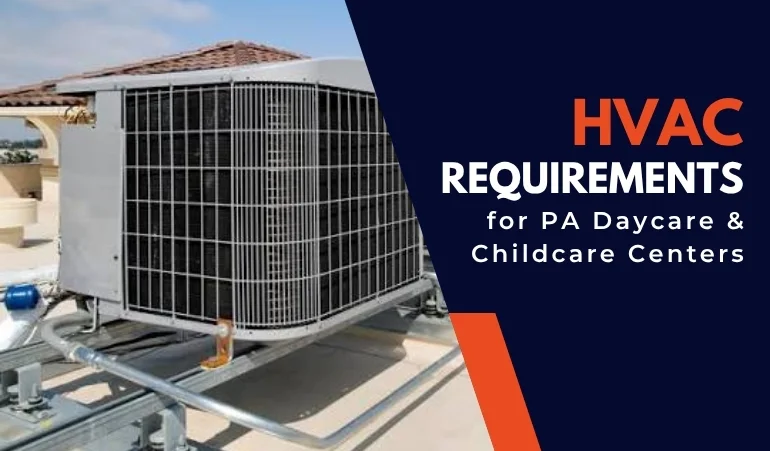
A safe, healthy, and comfortable indoor environment is the foremost priority for daycares and children's centers. Especially in Pennsylvania, where both winters and summers are at the extremes, a high-performing HVAC system is non-negotiable. And to keep your HVAC in a top-performing state, it is essential to understand the requirements of such facilities with respect to HVAC systems.
This blog covers the specialized HVAC requirements for daycares and children's centers in Pennsylvania. The guide is crafted after serving such facilities for over 11 years in this region.
HVAC matters a lot for childcare and daycare facilities because it regulates temperature, humidity, and air quality. If HVAC stops working for even an hour, it can have severe consequences on patient health. Apart from this, regulatory authorities in Pennsylvania require such facilities to operate within tight ranges of temperature, dampness, and other associated factors. This is why HVAC is a basic requirement of such facilities.
Childcare centers have more specialized HVAC requirements compared to standard commercial properties. What works well for standard facilities may not work well in favor of children. Here are the requirements for these facilities.
Young children breathe more air per pound of body weight compared to adults. It makes the minors more sensitive to contaminants. And this is why you have to maintain extremely healthy indoor air quality. You need an HVAC system that reduces the risk of
To get this outcome, you need high-quality air filtration and regular HVAC air filter replacement.
Ventilation is as important for childcare facilities as thermal comfort. Without proper airflow, the indoor air feels stuffy. It hurts both the children’s health and productivity. On the other hand, proper ventilation helps
Keep all the supply and return vents unblocked to ensure proper ventilation.
68°F and 75°F are the ideal temperatures for childcare facilities. This range is much narrower, and the temperature should be kept exactly within this range. Even a slight fluctuation from these ideal values translates into brutal consequences on both the child's health and the business’s reputation. The other main issue is that this range is not absolute. Various places such as classrooms, infant rooms, and nap areas have specialized temperature requirements. It is mandatory for HVAC to keep every zone at its required temperature, precisely regulated within the narrow range.
Wherever temperature is a concern in Pennsylvania, humidity is always alongside that. The fact is that summer humidity in this region frequently reaches its extreme, reaching up to 80 or 90%. It makes the air clammy, sticky, and somewhat uncomfortable even if the thermostat reading is normal. Your HVAC needs to maintain this humidity precisely within the normal range, which is between 30 and 60%. To keep humidity under control, you need to choose an HVAC of the right efficiency and the right sizing.
Modern, smart thermostats understand your day-to-day patterns and can automatically make the changes accordingly. For example, when the climate is normal, it can broaden the thermostat's temperature by a few degrees. It helps you save hundreds of dollars annually via energy conservation without compromising comfort.
To meet all the aforementioned requirements, you need to perform maintenance regularly. Here are the checkpoints we would recommend for your facility.
|
Maintenance Task |
Recommended Frequency |
|
Replace HVAC filters |
Every 1–3 months |
|
Professional HVAC inspection |
Quarterly |
|
Clean evaporator & condenser coils |
Every 6–12 months |
|
Calibrate thermostats |
Annually |
|
Inspect ductwork |
Every 2–3 years |
At Lehigh HVAC, we have been serving daycare and childcare centers in Pennsylvania for over a decade. We understand the unique HVAC needs for these facilities and how to achieve them for your facility. Contact us today to take a step towards maintaining your facility at its best for children's comfort.