Contact Info
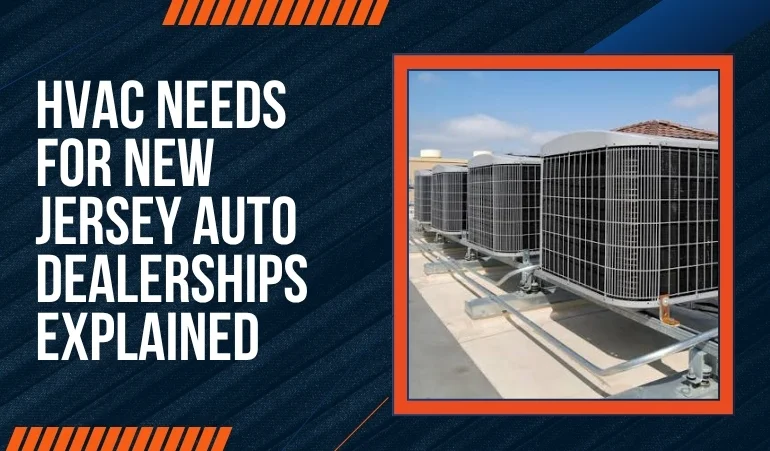
HVAC needs for auto dealerships are more challenging than standard commercial facilities. Spacious showrooms, high ceilings, service bays, and custom waiting areas—everything plays its part in HVAC planning. But with careful strategy, the right systems, and accurate installation, you can keep your automotive space comfortable at reasonable expenses. This blog focuses on specialized HVAC needs for New Jersey auto dealerships and automotive houses.
Auto showrooms differ from standard facilities. They combine spacious inventory areas, luxury, welcoming customer rooms, heavy equipment, and automotive spare parts under a single roof. The real challenge is to keep every room at its required temperature. Here are these setups' unique features.
The challenge is two-way. First, these facilities have a very distinct symmetry and building style that only experts can understand and plan for. Second, the New Jersey climate. Summers are hot and humid, and the winters are freezing with snowfall, while the shoulder seasons are completely unpredictable. This 4-season climate demands reliable heating and cooling units for year-round comfort. The space is another issue.
Generally, here are some HVAC challenges for these business places.
Challenges vary for automotive spaces, and so do the climate control needs. Ventilation, humidity control, and very precise temperature stability are required throughout business hours. A slight discomfort may result in up to a thousand dollars in lost revenue due to customer dissatisfaction.
Here is what Lehigh HVAC recommends specific to these facilities.
Large, glass showroom doors face direct sunlight that contributes to increasing the indoor temperature in summer. In winter, these storefronts create a different problem. They allow the warm air inside to escape outside every time a customer enters the space. As doors are spacious, the heat loss or gain significantly alters the indoor temperature.
The solution to this problem is in zoning technology. Either integrate zoning dampers and a dedicated thermostat setup with your current system or install a new system with built-in zoning technology. It ensures you have independent control over every zone's temperature, and you can balance comfort without putting an extra burden on the unit.
Though it is often neglected, it has a strong effect on indoor comfort, air quality, and energy bills. Hanging curtains on doors and windows minimizes energy loss when these glass entryways are opened. The other main benefit is that curtains prevent harmful outside contaminants from gaining direct entry into your space. In this way, they both conserve energy and improve indoor air quality as well.
Heavy machinery, labor, and equipment work generate very unhealthy gases. Make sure you have a well-maintained exhaust system that prevents smoke and harmful gases from causing both environmental effects and client discomfort. Additionally, code compliance is equally important here. Make sure your commercial facility follows the local building codes that are necessary.
Temperature alone is not a problem in New Jersey. Humidity is also a factor there. Even if the temperature is normal, the air inside can feel suffocating and clammy if the humidity is higher. This is why you should plan for humidity control. Either choose the HVAC that actually controls humidity effectively or install a separate whole-house dehumidifier.
Those times are gone when businesses used to set a desired temperature range on the thermostat, and the temperature control was followed. This is 2026, the time of automation. Now, your HVAC is integrated with apps, dashboards, and Wi-Fi to adjust heating and cooling cycles accordingly. You can consider installing smart or programmable thermostats for this purpose.
Contact Lehigh HVAC to get your NJ dealership ready for effective climate control in Pennsylvania.