Contact Info
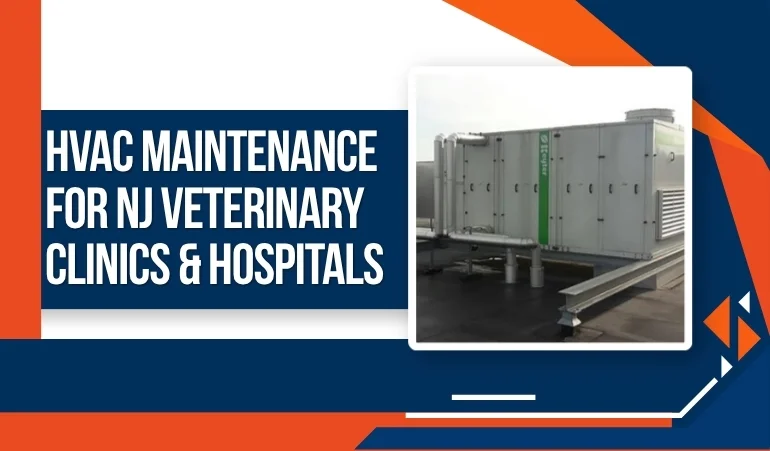
A reliable and high-performing HVAC is essential for veterinary clinics and animal hospitals in New Jersey. It is not just about the staff's comfort. It is essential for indoor air quality, preserving temperature-sensitive medications, and removing foul odors from the space, among others. A comfortable indoor environment is also non-negotiable to help animals recover fast from serious illnesses. In New Jersey, where summers remain extremely hot with temperatures between 80 and 90°F, HVAC maintenance is above everything.
In this blog, we will explore why HVAC maintenance is essential for veterinary clinics and how you can ensure it for your clinic.
Veterinary clinics have unique heating and cooling needs. Examination rooms, procedure areas, kennels, pharmacies—every zone needs its specific temperature maintained in a narrow range. Apart from this, there is a lot of dander, animal hair, and foul odors in the space. A high-performing HVAC is required to maintain indoor air quality in a normal range. As 40 to 60% of commercial energy is used on the HVAC, maintenance remains the top priority to minimize this energy consumption and keep bills under control.
Preventive HVAC maintenance is essential to ensure the unit is regularly in top condition. Here is what we recommend.
Inspect and replace your air filters every 30 to 90 days. If pet dander and air contamination are higher and there are increased risks, replace filters earlier than this. It is essential, as dirty air filters put extra strain on the system and lead to more energy consumption.
Schedule professional coil inspections every 6 to 12 months. It ensures cooling performance and prevents unnecessary energy consumption. Additionally, ensure fresh air is flowing through every room, kennels, and procedure sites.
Maintaining humidity between 30 and 60% is also essential. It prevents mold and mildew growth in the space and removes unpleasant odors. Maintaining the ventilation is also non-negotiable for the site, as without it the indoor air feels clammy and uncomfortable.
New Jersey's climate has multiple challenges that your veterinary clinic can’t afford to ignore. Here are some of them mentioned.
Summers in New Jersey are both hot and humid. The air conditioner struggles to keep both temperature and humidity levels under control. Fungal growth is beyond this, which quickly follows high humidity. Standard maintenance is not satisfactory for such facilities.
Winters in New Jersey are long, freezing, and come with snowfall. If your house is located somewhere around the coastline, salt air also joins the list. A standard system usually struggles to meet the demands.
Older veterinary facilities struggle to meet modern heating and cooling demands. Most often, such facilities have old and outdated rooftop units that no longer work efficiently to ensure reliable comfort. Beyond this, the airflow also remains poor in such facilities, which creates its own problems. There is a likelihood that older buildings have plumbing and electrical connections of ancient styles that are no longer compatible with the modern HVAC systems.
Here is what you expect to pay according to your facility size.
Facility Size Annual Maintenance Cost
Small veterinary clinic: $600–$1,200
Medium-sized practice: $1,500–$3,000
Large animal hospital: $3,000–$8,000+
Lehigh HVAC is a professional company serving customers with reliable services for over a decade. We understand how veterinary facilities differ from standard commercial places and what the unique requirements are for such commercial spaces. Schedule service with us and keep your HVAC at its top performance. Contact us at 848-361-4707 to discuss details.