Contact Info
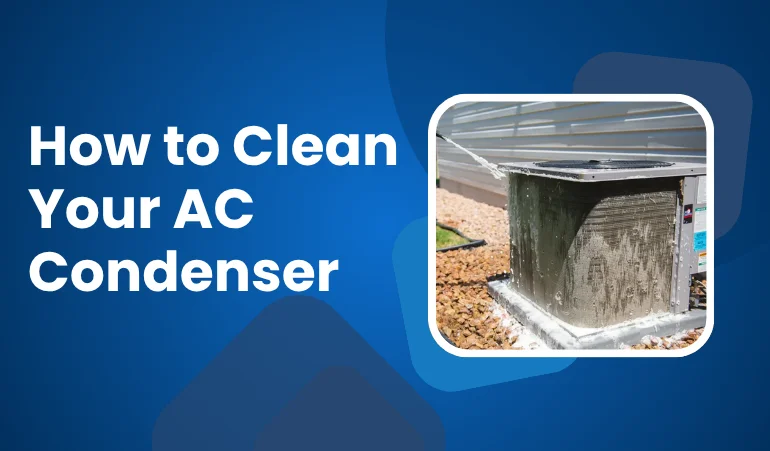
Your AC condenser sits outside the building. It captures dirt, dust, pollen, and other debris every day. Over time, this buildup makes a shield around the coils that traps heat instead of releasing it. It puts a burden on the air conditioner, leading to more energy consumption, longer cycles, and inefficient comfort. Studies show that dirty condenser coils reduce efficiency by 10 to 15% and incur higher energy bills. In New Jersey, where summer temperatures remain over 100 ℉, it causes something more than discomfort. All you need is to clean your AC condenser regularly to prevent performance issues and minimize the risk of emergency failures.
The good news is that you can clean your AC condenser yourself. The right set of tools and the right steps are everything you need to accomplish this task safely. In some scenarios, the cleaning needs a meticulous approach, and that’s where you need to hire a professional. In this blog, we will cover how you can clean your AC condenser via DIY and when you need to hire a professional. The blog is primarily designed to educate commercial HVAC customers across New Jersey.
The condenser is the heart of your AC. It is responsible for expelling heat outside. For this purpose, it contains multiple aluminum fins that provide a larger surface area for efficient heat transfer. When these fins or coils are blocked, there is less efficient heat transfer. As a result, the condenser becomes warmer than usual, interrupts the normal air conditioning process, and makes the AC work harder than it used to. Professional AC maintenance or complete condenser cleaning removes that buildup from the coils, after which efficient heat transfer happens, and your AC performs at optimal efficiency.
Cleaning an AC condenser is not a difficult job, but it needs a careful approach. A slight mistake at any step may damage your expensive equipment or may put your loved ones at risk later on. Here is the step-by-step process you should follow.
This is the first step, and it is extremely important for your safety. First, turn the thermostat off. Then, locate the metal box near the unit and pull out the switch. For an extra layer of safety, you should turn your circuit breaker to the "OFF" position. This ensures your AC gets no power supply, and there is no risk of accidental operation and damage.
Start with the surrounding region where your condenser is currently mounted. Trim all the grass, bushes, and tree branches that are in direct contact with the unit. Clear at least a 2 to 3-foot radius around the unit. It will prevent airflow blockage and allow efficient heat transfer.
Remove the case of the unit by removing nuts and bolts. You can use an ordinary screwdriver for this purpose, but make sure you don’t strain the fragile components. Also, prevent fraying, cutting, or scraping the wires. Once you have removed the case, take out all the visible buildup and scraps by hand. Ensure wearing gloves for safety. For complete cleaning, you can use a shop vacuum with a brush attachment.
At this stage, take a look at those aluminum fins. If you notice some fins are bent or misaligned, use a fin comb to bring them back to their proper place. This is delicate and must be handled with utmost care.
Rinse the area completely with a suitable foaming coil cleaner that is compatible with the unit. Spray it from the inside out. Wait for around 5 to 10 minutes to let the cleaner do its job. Now, rinse the entire unit with a garden hose, ensuring the pressure is not so high as to damage delicate fins.
Once the entire unit is cleaned perfectly, all the fins are aligned, and all the wires are in good condition, take some time to let the unit completely dry. After it gets dry, close the case. That’s it. Your AC condenser is now ready to operate at peak efficiency.
In certain circumstances, DIY is not satisfactory. Either it is risky, or it doesn’t deliver results. This is where you need a professional. Here are some of those scenarios discussed.
Refrigerant Leak
If you see ice forming around the coils, it is likely a refrigerant leak. Hire a professional who will fix it with specialized equipment and tools.
Severe Damage to Fins
If the fins are severely damaged or crushed and you can’t align them with a fin comb. A professional will either fix them or replace them.
Performance Issues
If there are other issues in the system, except the condenser. For example, you might be noticing strange noises, smells, frequent short cycling, or other issues that persist even after complete condenser cleaning. A professional will inspect the unit and bring it back on track.
If you are ready to hire a professional for condenser cleaning, Lehigh HVAC could be the right choice in New Jersey. We will bring experience, expertise, tools, equipment, and certified technicians to your site and get the job done professionally. Discuss more at 848-361-4707.