Contact Info
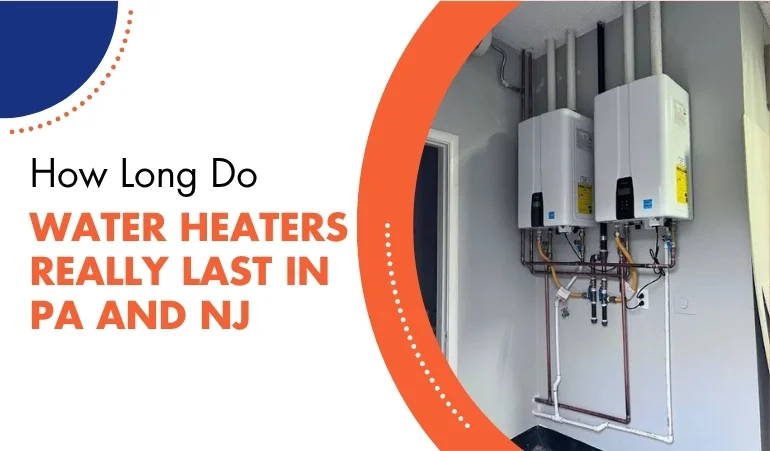
The national average age for a water heater is 10 to 12 years. But the observed one in Pennsylvania and New Jersey is a few years less than this. However, some units approach or even exceed the national average when kept with care and maintenance. If we strictly speak, tank water heaters last 8 to 12 years, while tankless models last 15 to 20 years. But remember, individual cases can have different lifespans depending on the workload, maintenance activity, and models.
This blog explores the real lifespans, affecting factors, and maintenance tips for water heaters in Pennsylvania and New Jersey.
The observed lifespans of water heaters in Pennsylvania and New Jersey are 2 to 3 years less than the national average. This is due to the harsh winters and water hardness. National surveys usually overlook these local factors. That’s why actual lifespan in these regions approaches expectations.
|
Water Heater Type |
National Average |
Local Lifespan |
Primary Regional Threat |
|
Traditional Tank (Gas/Electric) |
8–12 years |
6–9 years |
Mineral scale accumulation & severe winter thermal strain |
|
Tankless Water Heater |
15–20 years |
12–15 years |
Heat exchanger scaling from high mineral levels |
|
Hybrid / Heat Pump |
10–15 years |
8–12 years |
Low ambient temperatures in unconditioned basements |
Several local factors contribute to shorter lifespans. Some of them are
Water hardness is above average in most of eastern and central Pennsylvania and multiple cities in New Jersey. This water contains minerals such as calcium, magnesium, and dissolved iron. When the heater warms this water, these metals separate and form a layer at the bottom of the tank. This layer insulates the water from the heat exchanger. As a result, the heat exchanger has to work harder and longer to achieve the desired water temperature. This enhanced workload creates metal fatigue and leads to faster wear-and-tear fractures.
Winter temperatures are much lower in Pennsylvania and New Jersey compared to southern regions. Readings usually remain around 40°F. Converting this level of chilled water to 120°F requires an uplift of approximately 80°, which needs heavy work from the heater. And it is not just about the pressure; it causes metal expansion, which leads to premature wear and tear and corrosion.
Not just temperature, humidity is also a contributing factor for shorter water heater lifespans in mid-Atlantic regions. Basements and crawlspaces, where water heaters are usually located, are highly humid because these areas are often overlooked for air conditioning. This humidity contributes to corrosion, lining damage, and shorter system lifespans.
Having a close look at warning signs allows you to fix developing issues before they become a headache. Here is what to focus on:
With proper maintenance, servicing, and tune-ups, you can prolong your system lifespan by 2 to 3 years. Here is what Lehigh HVAC recommends.
Water heater lifespans are shorter than national averages in Pennsylvania and New Jersey. This is due to hard water, high humidity, and freezing temperatures, which put extra burden on the system and lead to wear and tear. Regularly checking the system, resolving red flags, and scheduling professional maintenance ensures your system remains in top condition and runs smoothly.