Contact Info
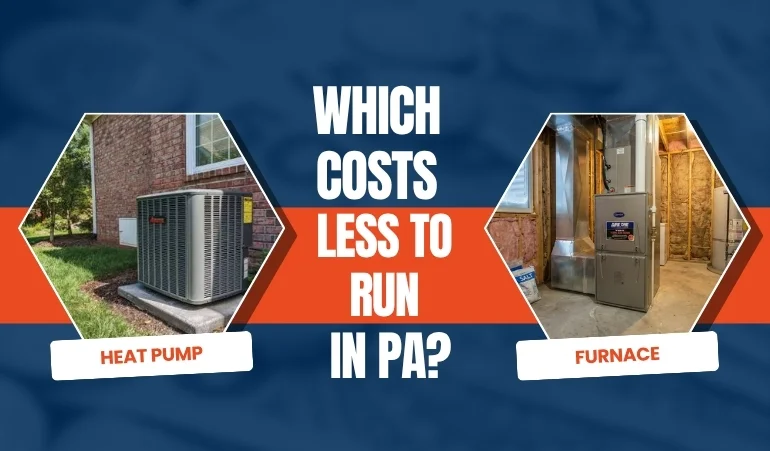
When winter woes strike Pennsylvania, a reliable heating source becomes essential for homeowners. Homeowners contact HVAC companies, manufacturers, and contractors, seeking advice for the right heating system. It takes some days to visit the customer’s site, understand fuel availability, and strike a balance between the comfort needs and operational costs. In the meantime, cold and snow make life uncomfortable for their family members. Why not take a moment to plan in advance, knowing urgent decisions are not always right?
This blog will take you 5 to 10 minutes. In return, it will disclose a complete picture of whether a heat pump or a furnace is inexpensive to run in Pennsylvania. Understand it now and plan smarter for the upcoming winter.
Annual Costs at a Glance
A heat pump usually costs between $700 and $1,000 annually in Pennsylvania. A natural gas furnace on the other end costs $1,000 to $1,300 per year. The installation costs for a standard gas or oil furnace range from $4,000 to $9,000. The installation cost for a central heat pump is, however, from $8,000 to $22,000.
This was a brief overview. The detailed picture is presented below.
Pennsylvania experiences longer winters with high humidity, cold winds, and snow. The temperature drops to below zero in the peak months. The shoulder months usually have milder temperatures. The summers are accompanied by high temperatures along with humidity that makes the indoor environment feel clammy. In this context, running a gas furnace is usually cheaper in Pennsylvania during the cold season. But if we look at the whole year, a heat pump is more economical (less expensive) to operate.
Operational costs vary greatly depending on the equipment type, climate situation, working conditions, and equipment efficiency. There is a possibility that the costs for running a very high-efficiency heat pump in winter might be less than running a low-efficiency furnace in the same period. The costs also depend on the fuel type and per-unit fuel rates. The following is a more comprehensive overview of costs for various equipment.
|
System Type |
Fuel Source |
PA Average Rate |
System Efficiency |
Annual Running Cost |
|
Electric Heat Pump |
Electricity |
~$0.20 / kWh |
200% – 400% |
$800 – $1,400 |
|
Natural Gas Furnace |
Natural Gas |
~$1.60 / therm |
80% – 96% AFUE |
$1,200 – $1,500 |
|
Propane Furnace |
Propane |
~$2.85 / gallon |
90% – 95% AFUE |
$1,800 – $2,200 |
|
Oil Furnace |
Heating Oil |
~$3.40 / gallon |
80% – 85% AFUE |
$2,200 – $2,600 |
Choosing a system with low operating costs never ensures you secure the best deal. The right equipment, in your case, can be the one that fits your needs, fuel availability, and budget. Here is when each piece of equipment makes the best choice.
Choosing a gas furnace makes sense when:
Choosing a central heat pump makes sense when:
Choosing a dual fuel (hybrid) system makes sense when:
If your question is strictly "Which costs less to run in PA?" the best answer is a heat pump over a full year and a furnace in a particular winter season. The hybrid system (both furnace and heat pump in the same unit) can, however, be the perfect balance. If you want to enjoy comfort all year long with a single HVAC system and want to save on costs, a heat pump is the ideal choice.
Contact Lehigh HVAC for expert installations and repairs, whether it is a furnace, heat pump, or hybrid system. Discuss project details at 484-961-7044.