Contact Info
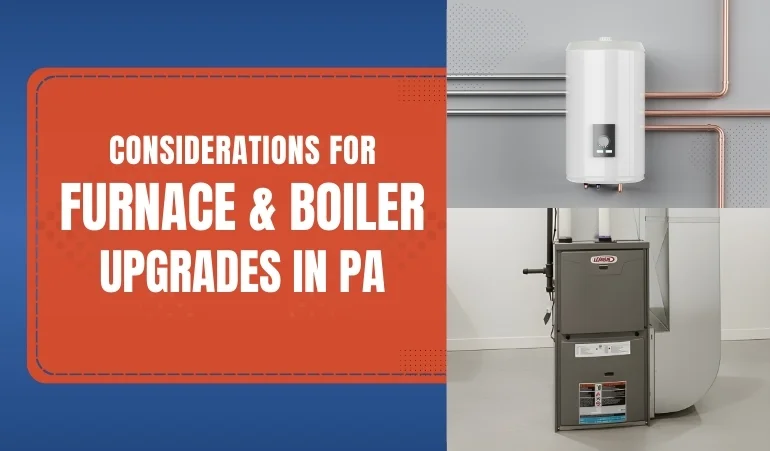
Both furnaces and boilers are reliable sources of comfort during long winters in Pennsylvania. Similar to other HVAC equipment, boilers and furnaces also need an upgrade after a specific time duration. Multiple financial and safety benefits accompany the timely upgrades. Understanding the right factors for an upgrade can help you save money, reduce energy bills, and minimize the risks for repairs.
In this blog, we will explore the factors to consider before upgrading boilers or furnaces. Let’s cover them section by section.
Before undertaking a new residential or commercial heating installation in PA, determine whether you actually need a new system or just a repair. Here are some of the signs that help you make the right decision;
Frequency of Repairs: If your current heating unit runs into issues more often, you need an upgrade.
Inconsistent Heating: If there are cold spots in your home or uneven temperatures in various parts, you need an upgrade.
Rising Utility Bills: If there is a continuous increase in energy bills despite every component being up-to-date, an upgrade is the best solution.
Strange Noise and Smells: If there are strange noises and smells coming from the appliance, an HVAC upgrade must be considered.
Safety Hazards: If there are serious health or safety hazards like CO poisoning or explosion risks, a new appliance should be installed.
In Pennsylvania, a lot of models and sizes of heating appliances are available. Each unit has its own specifications and is best for specific comfort goals. A residential furnace installation in PA is distinct from boiler installation at a commercial site. The same is true for heat pumps and mini split systems. Here are some of the factors that must be considered before every upgrade;
Climate is the factor that directly influences the efficiency, performance, and lifespan of the equipment. Pennsylvania’s long winters with extreme cold put a high demand on the HVAC equipment. Understanding the winter patterns, temperature variations, and climate strain can help you choose the system with the right capacity and performance.
Fuel type must be considered before upgrading a boiler or a furnace to ensure cost-effectiveness and uninterrupted operation all season long. There are three main types you can choose from;
Gas Boilers & Furnaces: This is the most common and cost-effective boiler or furnace type in many areas across Pennsylvania. It supports high-efficiency systems and is more popular in urban and suburban counties.
Oil Boilers & Furnaces: It is a better option for rural areas that lack a stable supply of natural gas. They generally have higher operating costs than gas boilers or furnaces, but come with the freedom of fuel supply.
Electric Boilers & Furnaces: These units are more efficient and require less maintenance than the above two. The prices are based on the electricity costs in the region. They are also more environmentally friendly than other units.
The correct size is essential for smooth operation and uninterrupted heating. An undersized unit will struggle to match the temperature according to the range set on the thermostat and may fail in a higher temperature variation. An oversized unit, on the other hand, will lead to energy waste due to frequent on/off cycles. It is better to calculate the manual J load of the building and choose the system that better matches the requirements.
Efficiency ratings like AFUE (Annual Fuel Utilization Efficiency) are all about how much of the input energy is converted into an output. Most of the standard systems in Pennsylvania have 80%–85% ratings, while some high-efficiency units have 90%–98% efficiency. Higher ratings mean more energy converted to heat, reduced waste, and lower energy bills. You must also consider the ENERGY STAR requirements of ratings in your area and other local or state-level criteria.
Prices of boilers and furnaces vary greatly depending on the system’s size, specifications, and fuel type. The smart decision is to balance the initial cost with long-term benefits. You must consider the available rebates, incentives, and financing options to reduce the cost burden to the maximum extent. Quality units might initially cost a bit higher, but they accompany ROI in terms of fewer bills, more comfort, and easy maintenance steps.
In Pennsylvania, there are fantastic rebates and tax credits offered for certain qualifying units. Many local companies also offer various financing options for eligible units and installation services. UGI, PPL, and PECO are some of the firms that offer incentives for a range of units. Some companies, like Lehigh HVAC, offer 0% financing options on HVAC services in PA, including boilers and furnaces. All these collectively can reduce the cost burden if you take the best advantage of them.
The failure of your previous boiler or furnace might be due to the wrong installation techniques, incompatible accessory products used, or incorrect insulation. That’s why installation services are one of the most important factors to choose wisely. Whether it is residential heating installation in PA or setting up a furnace at a business location, choose only the technician who is experienced, knowledgeable, and skilled. It will prevent you from the headache of repairs and complex maintenance procedures.
A boiler or a furnace upgrade is a significant investment for a business owner or a homeowner. It must be approached with smart planning and strategy. Consider the factors such as climate strain, efficiency ratings, system sizing, rebates and incentives, and the quality of installation services. It will help you make a smart decision and get the maximum ROI of your investment.
If you want to keep yourself away from the trouble of checking every factor by yourself, Lehigh HVAC presents you with the best solution. You can contact our team, and we will handle everything on your behalf. We will inspect your current unit, look for warning signs, and suggest the best move. In case of an upgrade, we will choose the unit considering all the above-mentioned factors so your system keeps performing at its best all season long. Contact us at 484-961-7044 to learn more about our services.