Contact Info
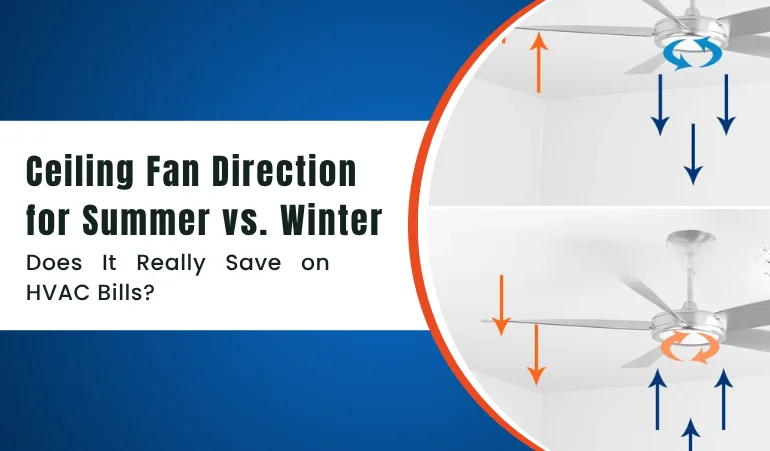
Set your ceiling fan direction to counterclockwise in summer and clockwise in winter. This single shift can reduce your energy bills by up to 10%–15%. Plus, it can provide you with greater comfort in both seasons without placing an extra burden on your HVAC system.
In this blog, we will explore the impact of ceiling fan directions on energy bills and which directions are best for the summer vs. the winter season. We will also explore the core mechanism behind this shift. The blog is specifically designed for residential and commercial HVAC systems in Pennsylvania and New Jersey.
The direction of the ceiling fan matters as it manipulates air circulation to complement heating and cooling. You can feel the same level of comfort at a 5-degree higher temperature in summer if the ceiling fan is spinning in the right direction. Similarly, you can drop your thermostat temperature 3 to 5 degrees lower in winter and still feel the same level of warmth, just because the fan is spinning in the right direction. And yes, it affects utility bills also. When the ceiling fan is contributing towards comfort, you can raise the thermostat temperature in the summer and drop it in the winter. As a result, your HVAC system performs at reduced pressure, consumes less energy, and incurs fewer bills for you. That's it. And this is why the direction of the fan is important.
The ceiling fan direction in summer should be counterclockwise. It produces a wind chill effect by creating a downdraft. It means the cool air is now pushed directly downwards. It makes residents feel up to 4℉ lower without lowering the home's actual temperature. Applying this effect, you can just raise your thermostat temperature a few degrees higher, and you will still enjoy the same level of comfort. And as mentioned earlier, it helps you cut down the cost of monthly utility bills.
The ceiling fan direction in winter should be clockwise. It creates an updraft, which directs the cool air upward, toward the ceiling. As a result, warm air is distributed downward, contributing to the warmth. Operating your fans at a slower speed reinforces this effect and helps spread the warm air evenly inside. Just like we discussed for summer, this single shift can help you feel warmer even if the home's temperature is lower. And for winter also, it helps you reduce the amount on your monthly utility bills.
Stand just below the fan. Notice its motion closely. If its blades are spinning from right to left, it means it is rotating counterclockwise and set for summer. If its blades are spinning from left to right, it means it is rotating clockwise and optimized for winter. When it is set for summer mode, you'll feel a cool breeze standing underneath the fan. Conversely, when it is set to winter mode, you'll feel warm air distributed inward instead of a cool breeze. However, increasing your fan speed may spread a cool breeze inside. That's why it is always recommended to keep the speed low in winter.
When spinning in the right direction, a ceiling fan complements an air conditioner. It reduces the burden on components and allows you to feel the same level of comfort while operating your HVAC systems at less pressure. Let's understand this via example.
Imagine it is a hot day in July. You turn your AC system on and set the thermostat temperature to 76℉. You notice your system is struggling to achieve this temperature, or you fear it will incur higher bills. You make a smart move. You increase the thermostat temperature to 80℉ and start the ceiling fan, spinning it in a counterclockwise direction. Now, you will feel the same level of comfort as you would have enjoyed at 76℉. But now, you will have to pay a lower monthly bill compared to what you would have otherwise paid at a thermostat temperature of 76℉. This happens because a cool breeze increases evaporation of moisture from your skin, and you feel cool. You might have noticed this effect when traveling in a car with the car windows open. Similarly, you feel warmth in winter by spinning your fan clockwise.
You can change your fan direction depending on its model and mechanism of operation. First, turn the fan off. Wait until the blades stop moving. Now, change the direction and turn it on again. Here are some ways to change its direction.
Pull-chain fans have a fan switch that you can use to change their spinning direction. Turn the fan off and wait until it comes to a stop. Locate the fan switch. Change its direction and turn the fan again. Confirm whether it is spinning in the opposite direction now.
Fans with remotes have an innovative option of reversing the spinning direction via a single push button. It reverses the fan direction without accessing the blades themselves. For this fan type, also, turn the fan off. Wait until it comes to a complete stop. Press the push button and hold it. When the light blinks, leave the button and turn the fan on again. Confirm whether it now rotates in the opposite direction.
There are multiple smart fans in operation in both Pennsylvania and New Jersey, or maybe in the entire USA. These fans have a unique feature: they can be attached to a smartphone, tablet, or another device. Some fans also come with handheld remotes for those who are not technically good at these smart devices. Whichever the method is, it makes it easier to change the fan direction with a single click.
For these fans, turn the fan off and wait until it stops. Open your device and toggle the fan direction option. Choose your desired direction from clockwise and counterclockwise. Set it, and turn the fan back on. You can also change the direction via a voice command in many fans.
A ceiling fan doesn't reduce bills by making the air colder or warmer. It reduces bills by tricking the thermostat.
Here is a quick breakdown.
In summer, the wind chill effect allows you to raise the thermostat temperature by 4℉ to 6℉ without losing comfort. With this move, you can reduce approximately 3% on your monthly cooling costs.
In winter, a ceiling fan can make you feel warmer than the actual temperature in your space. As a result, you can just drop the temperature to a few degrees lower without losing the comfort. It can also reduce your energy bills.
When fans are doing the heavy lifting, your HVAC appliance runs up to 15% less than usual. It causes reduced wear and tear on the components. As a result, your equipment stays functional for longer periods. It also cuts the cost of AC repairs or heating repairs, HVAC maintenance, tune-ups, and costly component replacements.
The ceiling fan is a low-wattage tool that allows your high-wattage HVAC system to take a break. If the fan is spinning the right way, the HVAC system works less to achieve the same comfort level. Contact Lehigh HVAC at 484-961-7044 for expert guidance regarding your HVAC systems.