Contact Info
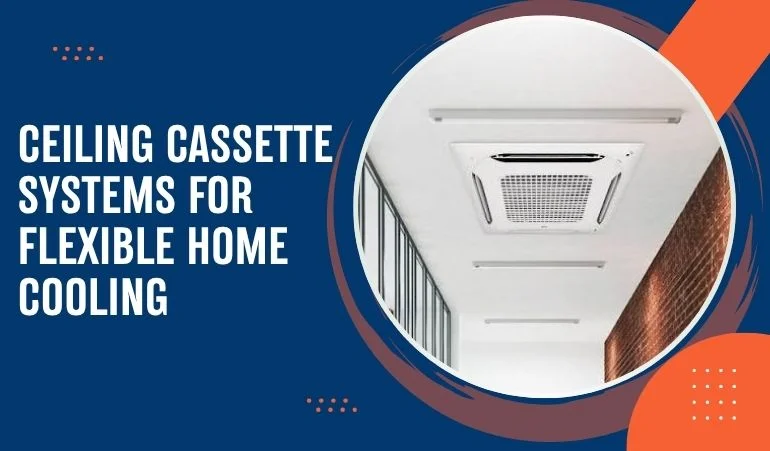
Standard HVAC systems are not the best option to install in every building. Sometimes, due to space concerns, it is not possible to install the heating and cooling appliance on the wall. This is where ceiling cassette systems come in. These innovative design systems can be directly installed in the ceiling. They evenly distribute the warm or cool air inside the rooms and keep them at the desired temperature.
This post explains what ceiling systems are, how they work, when they are useful, and how they differ from standard systems.
Ceiling cassette systems are similar to mini-split systems in many ways. They connect to the outdoor heat pump or air conditioning unit through the refrigerant line. But unlike the well-mounted indoor unit distributing the warm or cool air in the space, they distribute the comfort directly from the cassettes in the ceiling. Many advanced models have built-in features that allow them to distribute air evenly downward, so the complete home stays at the relatively even temperature.
Ceiling cassette systems work on the same principle as mini-split systems. The outdoor unit handles the heat transfer while the indoor unit distributes that heat in the entire room.
Here is the process in a few words.
The indoor cassette draws warm room air into the unit.
The system conditions the air using the indoor coil.
The conditioned air moves through the ceiling vents.
Air spreads across the room in multiple directions.
The system repeats the cycle to maintain comfort.
In the cooling mode, the heat travels to the outdoor unit through the refrigerant line and is expelled outside. In heating mode, the heat pump model in the outdoor unit adds heat inside, which is carried away by the refrigerant and distributed through the cassettes.
Ceiling cassette systems are not essential for every home. They find their best applications in homes or offices where a standard unit doesn’t fit accurately. Here are some scenarios when these units are best used.
Limited wall space for indoor HVAC units
Open rooms that need wider air distribution
Rooms with large windows or glass walls
Home additions without existing ductwork
Spaces where a cleaner appearance is preferred
Rooms with unusual layouts or limited floor space
Zoned heating and cooling applications
Homes where duct installation is impractical
Both units have parallel features. Both are ductless. Both provide zoned heating and cooling. The difference is where they are mounted and how they distribute the air.
Here is a brief comparison.
Feature |
Ceiling Cassette |
Wall-Mounted Mini-Split |
|
Indoor Unit |
Ceiling-mounted |
Wall-mounted |
|
Ductwork |
Not required |
Not required |
|
Air Distribution |
Multiple directions |
Mainly outward |
|
Wall Space |
Mostly preserved |
Requires wall space |
|
Appearance |
More discreet |
More visible |
|
Installation |
More involved |
Usually simpler |
|
Best For |
Open or difficult layouts |
Standard rooms |
Ceiling cassette systems are highly energy-efficient, though the exact efficiency depends on the model, brand, and equipment size. They help you save energy and control in many ways. First, the heating and cooling cycles are highly optimized. Energy is not wasted during these cycles. Second, you can control which areas to keep at which temperatures. For example, the areas with fewer visitors can be kept at a slightly higher temperature during summer and a slightly lower temperature during the winter. In this way, you can both control your monthly bills and prevent strain on your heating or cooling unit.
Lehigh HVAC has been serving New Jersey with on-demand HVAC services. For your ceiling cassette installation, you can book us with confidence. Whether it is ceiling cassette heat pump installation or air conditioning installation, we handle everything professionally. Contact us at 484-961-7044.