How to Fix Frozen AC Coils?
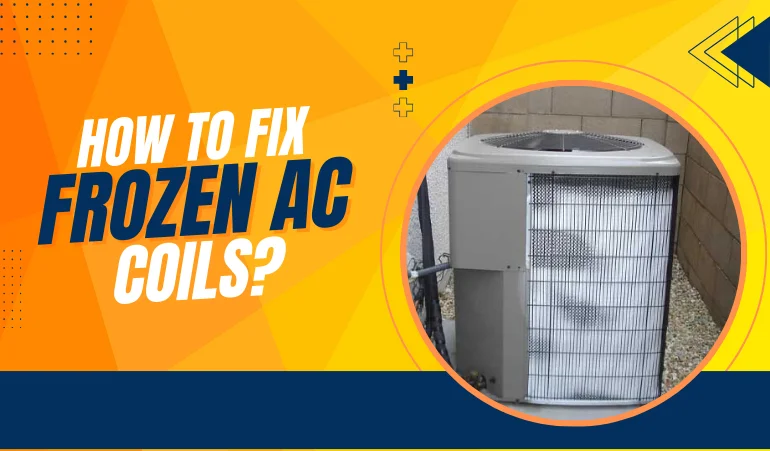
Your AC relies on two coils, a refrigerant, and some associated components to cool your home. These coils are condenser and evaporator coils, and the process carried out is the air conditioning process. Sometimes, these coils are frozen, blocking the entire pathway and rendering the AC unit non-functional. Before booking an AC repair service, you must have knowledge of the root cause, the possible solutions, and the repair costs. It will help you get your air conditioner restored fast, effectively, and at a reasonable price.
This blog is crafted to educate homeowners across the USA and, specifically, across New Jersey about the reasons for frozen AC coils and what to do to fix them.
What are Evaporator & Condenser Coils & Why They are Named So
Let’s start with the very basics. Evaporator coils are the indoor coils. They absorb the heat from rooms and deliver it to the refrigerant flowing. Condenser coils, on the other hand, are the outdoor coils. They get the heat from the refrigerant and expel it to the outside.
Both coils are named after the process that occurs when they absorb or release heat. Evaporator coils are named after evaporation, the process that turns the liquid refrigerant into vapor. This process occurs as heat is transferred to the refrigerant. The condenser coils are named after condensation, a process in which these coils expel heat outside and refrigerant vapors are condensed back into liquid.
What Happens If AC Coils Are Frozen?
AC coils are one of the most essential components of an air conditioner. When they are frozen, the entire process is disturbed. If left unchecked for extended periods, these issues can render your system non-functional, forcing you to install a new AC system. Here are some effects of frozen AC coils, as observed in many areas across New Jersey.
- Reduced cooling or airflow
- The AC starts blowing warm air
- Increased energy consumption
- Leaking water around the unit
- Permanent system damage
Common Causes of Frozen AC Coils
The causes of frozen AC coils are diverse. A few very common ones are mentioned here.
Clogged Air Filters
This is the primary cause of not just frozen coils, but also of multiple other AC issues. When the air filters are dirty, the entire airflow is blocked. Now, the refrigerant inside the coils can’t absorb heat. As a result, the temperature of the coil drops, which turns the condensation into ice.
Blocked Return Vents
This is also linked with the air filter issues mentioned above. When the return vents are blocked, there is a disruption in the smooth airflow. Ultimately, the process of heat transfer can’t complete, the temperature of the coils falls, and ice starts building in the coils.
Low Refrigerant Levels
Low refrigerant levels are also responsible for frozen coils. This most commonly happens when there is an accidental refrigerant leak. Due to low levels of refrigerant liquid, the pressure of the system falls. As a result, the temperature of the coils drops below freezing, and ice forms in the coils.
Faulty Components
Component failure might also be responsible for frozen coils. Especially when some components of the blower motor or blower fan are malfunctioning. Due to this fault, the air movement is not appropriate, which disturbs the heat transfer process, and ice starts building in the coils.
Expert Tips to Fix Your Frozen AC Coils
When your air conditioner coils are frozen, don’t make the mistake of turning your AC on. It can cause irreversible harm to essential components, forcing you towards expensive repairs. We recommend getting your coils fixed and restored, and the root cause eliminated, before you start using your AC again. It also applies to mini split repairs and rooftop AC repairs, apart from the central air conditioner units.
Here is the step-by-step approach to get your cooling system back on track.
- Turn your system off.
- Change the thermostat setting from cool to off.
- Change the blower fan setting from Auto to On.
- Wait for some hours until the ice thaws.
- In the meantime, call for professional help.
- Don’t turn on the AC until a technician arrives.
Conclusion
Both the condenser and evaporator coils are essential for the normal functioning of an air conditioner. Sometimes, these coils are frozen due to restricted airflow, component failure, or a refrigerant leak. Regardless of the causes, you have to be very careful when you face such situations. The experts at Lehigh HVAC recommend turning the system off and the blower motor on to speed up the thawing process. After these safety steps, you should immediately call your local HVAC pros to fix the issue.
If you are anywhere from New Jersey to Pennsylvania, you can call Lehigh HVAC for professional and timely HVAC service. We will come promptly, inspect the issue, and restore your functional air conditioner on the same day, preferably.