How Smart Thermostat Installation Provides Multi-Zone Cooling
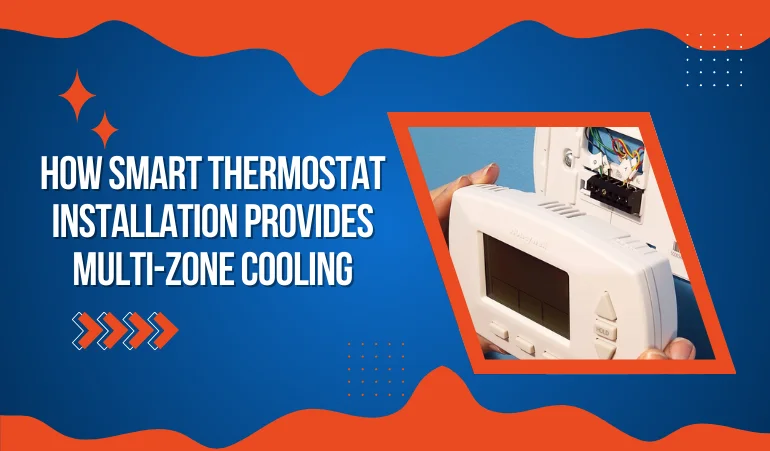
Over the last few years, smart thermostats have become very popular in the HVAC industry. It is due to their multi-zone cooling, one of the primary requirements nowadays. In this blog, we will be exploring the practical mechanisms of how smart thermostats offer you personalized control and multi-zone cooling. We will also discover the benefits associated with them.
What is a Smart Thermostat?
Though becoming increasingly popular, many customers across New Jersey and Pennsylvania still don't know much about the smart thermostats. This is, however, the basic information you should have.
A smart thermostat is a Wi-Fi-enabled device attached to your HVAC system. It learns your everyday schedule and manages your heating and cooling accordingly. Unlike traditional ones, smart thermostats can be connected to Wi-Fi. They can also be accessed through a remote or mobile app. They are designed to automate temperature regulations in your space.
Working Mechanisms of a Smart Thermostat
A smart thermostat operates through highly coordinated operations of multiple components. Here are some components with their basic functions they perform:
Digital Sensors: They monitor room conditions, occupancy, and humidity levels.
Wi-Fi and App Control: The device can be connected via Wi-Fi. You can control it through your mobile app or voice commands.
Learning and AI: These devices learn the temperature preferences and make a schedule. This schedule aligns with your comfort preferences and routine.
Geofencing: It fetches your smartphone location and prepares your HVAC system accordingly. For example, when the last person has left the room, it will turn the energy saver mode on. Similarly, when it detects you coming back, it turns the system back to optimized cooling mode.
Smart Thermostats and Multi-Zone Cooling
Traditional thermostats act as the sole temperature regulation point. Smart thermostats dismantle these limitations. They allow you to control the temperature of each zone and each room independently. Here is how this happens.
Remote Sensor Integration
Multiple small, wireless sensors are placed in different areas across the same building. For homes, the ideal places are living rooms. These sensors collect the temperatures of different places and send signals to the main control panel. As a result, your system manages the temperature and the humidity levels of the different rooms.
Smart Vent Systems
For homes with central air conditioning installation, the zoning can also be achieved at the register levels. This is achieved through replacing traditional floor or ceiling registers with the smart vents. These vents communicate with the thermostat efficiently. As a result, your HVAC system closes or opens vents depending on the needs of each zone. Smart systems also monitor the backpressure, so closing one vent doesn't put an extra burden on the system.
Dedicated Dampers
This is where you get professional-grade zonal control. The dampers are physical plates that are installed in your ducts. These plates act like traffic cops. A zone control panel links these dampers with the thermostat. When the upstairs zone calls for the cooling air, the dampers for the downstairs zone close. As a result, 100% air is funneled towards the upstairs zone.
Benefits of Zonal Cooling With Smart Thermostats
Smart thermostats are not limited to personalized temperature control only. They are also accompanied by multiple other benefits. Some of them are mentioned here:
Energy Efficiency
This is the benefit that recovers the investment made for smart thermostat installation. They allow you to adjust the temperature of each zone independently. You can keep the comfort limited to only those areas where it is required. You can cut off the cooling to low-traffic areas such as attics, crawlspaces, and basements. All this helps you reduce monthly energy bills as there is less energy consumption.
It makes both residential and commercial AC installation as affordable as you need.
Remote-Controlled Convenience
Modern homeowners and property managers demand convenience in addition to affordability. Smart thermostats also check this point. They allow you to adjust the temperature of your living space from anywhere. You just have to take out your phone, open the app, and change the temperature preference with a finger tap.
Improved Comfort
With traditional thermostats, you can set a desired temperature range. The system then works harder to achieve that range, whether there is an actual need or not. But with a smart thermostat, comfort is achieved according to the climate. At one end, it prevents an overload on the HVAC system, and at the other end, it provides you with the best cooling according to the climate demands.
Maintenance Reminders
Smart thermostats are integrated with all the components of your HVAC system. They monitor the performance of the parts and send you maintenance or tune-up reminders accordingly. For example, when the air filters are closed, it will send you a reminder to replace the air filters before major damage happens.
Conclusion
Smart thermostats are becoming increasingly popular for HVAC systems. They offer fantastic features, including personalized temperature control, energy efficiency, and extraordinary convenience. Smart thermostats also keep your HVAC system performing at an optimal rate. They send you reminders when there is something wrong with some parts. Investing in them can give money back via reduced residential or commercial AC repairs.
Contact Lehigh HVAC at 484-961-7044 for professional smart thermostat installation. We serve both residential and commercial sites.